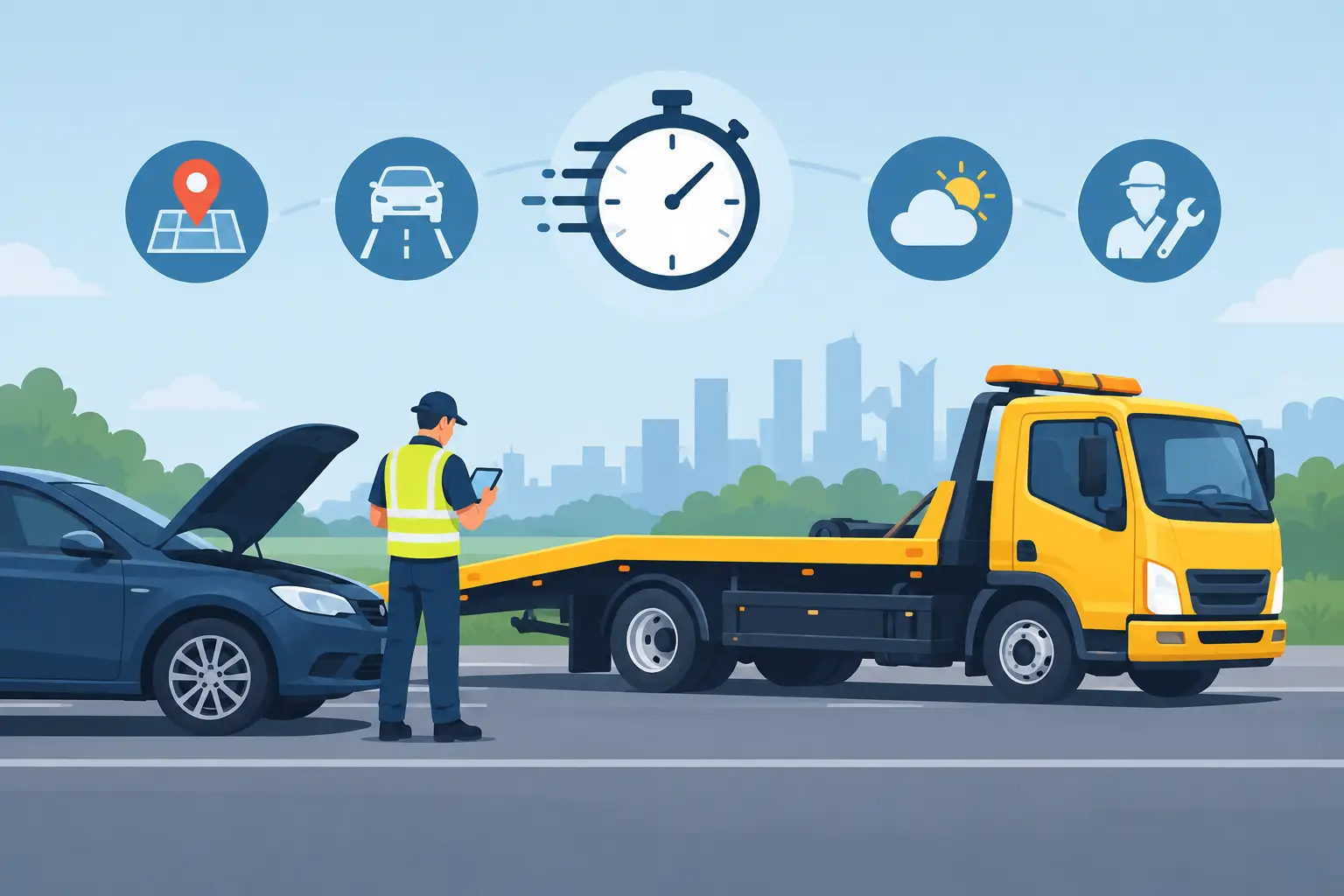
A dead battery in a Surprise shopping-center lot and a disabled vehicle on I-10 may both require a tow truck, but they do not carry the same arrival conditions. Tow truck response time factors are not just about how close a truck appears on a map. Dispatch has to match the right operator and equipment to your location, vehicle, and roadside situation while keeping everyone safe.
When you call for emergency towing or roadside assistance, a reliable provider should give you a realistic estimated arrival time, not a guess made before the details are known. Knowing what affects that ETA can help you give dispatch the information they need and make the wait safer and less stressful.
Tow Truck Response Time Factors in the West Valley
Response time usually begins with location. Surprise, Peoria, Glendale, El Mirage, Sun City, Sun City West, Waddell, and the surrounding West Valley cover a large service area connected by local streets, construction zones, and high-speed freeways. A truck already positioned near your location can often reach you quickly. If the closest available operator is completing another call or is across town, the ETA changes.
The exact place where your vehicle is stopped matters as much as the city. A car in a well-marked parking lot is generally easier to locate than one on a freeway shoulder, an unpaved road, or a desert trail without a clear address. Major routes such as Loop 303, US-60, I-10, and I-17 can move quickly one minute and become heavily congested after a crash, roadwork, or rush-hour backup the next.
Traffic, road closures, and weather conditions
Tow operators deal with the same traffic conditions as everyone else, but they also need room to safely enter, position, and exit an incident scene. A lane closure, blocked frontage road, police activity, or collision can delay access even when the truck is only a few miles away. Freeway calls may require a safer approach route than the route a navigation app initially suggests.
Phoenix-area weather creates its own delays. Monsoon rain can reduce visibility, flood low spots, and make dirt roads impassable. Extreme summer heat increases breakdown volume, especially for batteries and cooling systems, which can affect truck availability during peak periods. These conditions do not mean help is unavailable. They mean dispatch must plan for a safe arrival instead of rushing an operator into a hazardous situation.
Available trucks and the type of call
A towing company may have multiple trucks on the road, but not every truck is the correct truck for every job. A jump start or lockout can often be handled by an available roadside operator. A disabled SUV, a motorcycle, a low-profile sports car, or a vehicle involved in a collision may require a specific setup.
Flatbed-capable equipment is often the preferred choice for all-wheel-drive vehicles, luxury vehicles, classics, motorcycles, and cars with low ground clearance. A winch-out from a ditch, wash, or soft shoulder may need recovery equipment and an operator trained to assess anchor points, terrain, and the vehicle’s position. Sending the wrong truck quickly creates more delay and can create avoidable damage. Matching the call correctly from the start is faster in the way that matters.
Scene safety can affect the arrival and loading process
The arrival time is only part of the service timeline. Once an operator reaches the scene, they may need to establish a safe work area before loading your vehicle. On a busy freeway shoulder, that can include evaluating traffic flow, shoulder width, vehicle position, and whether law enforcement or fire personnel are directing the scene.
A vehicle that has rolled into a ditch or left the pavement requires additional caution. Pulling without a proper recovery plan can damage suspension components, bumpers, steering parts, or the undercarriage. The same is true for a collector car with limited clearance. A few extra minutes spent using the right loading angle, soft straps, and securement points can protect an asset that is worth far more than a rushed recovery.
How Your Information Affects Tow Truck Response Time
The fastest way to help dispatch is to provide a precise location and an accurate description of the problem. If you are on a freeway, share the direction of travel, nearest exit, mile marker if visible, and whether you are on the shoulder, ramp, or in a travel lane. On local roads, provide the cross streets, business name, or a recognizable landmark. If your phone map shows a pin, confirm that it matches where the vehicle actually sits.
Describe the vehicle by year, make, model, color, and condition. Let dispatch know if it is lowered, all-wheel drive, has locked wheels, a flat tire, front-end damage, missing keys, or is parked in a garage with low clearance. Motorcycle riders should mention whether the bike is upright, on its side, or inaccessible behind a gate. These details help ensure the operator arrives prepared rather than needing a second trip or different equipment.
It also helps to explain what has already happened. A simple flat tire is different from a tire that came apart and damaged the fender. A no-start condition may be a battery issue, or it may be a vehicle that cannot be shifted into neutral. Clear information allows dispatch to prioritize the right response while giving you a more dependable ETA.
What to Do While You Wait for a Tow Truck
Your safety comes first. If your vehicle is stopped in a dangerous position and you can move it safely, get out of traffic and onto a stable shoulder or nearby parking area. Turn on hazard lights. At night, keep interior lighting low enough that you can still see approaching traffic, and stay alert around the vehicle.
On a freeway or other high-speed roadway, move away from the traffic side of the vehicle when it is safe to do so. Do not stand between your vehicle and passing traffic, and do not attempt roadside repairs where another driver could strike you. If the vehicle is in a travel lane, has been involved in a collision, or creates an immediate hazard, contact emergency services first.
Keep your phone charged if possible and listen for calls or texts from dispatch. A missed call can slow down a driver trying to confirm a location, especially at apartment complexes, gated communities, large shopping centers, or remote desert access points. If you need to leave the vehicle for safety, tell dispatch where the keys are and how the operator can identify the car.
Why a Realistic ETA Is Better Than an Empty Promise
A quick ETA is valuable, but only when it reflects the actual conditions on the road. The nearest suitable truck, traffic, weather, the complexity of the recovery, and the operator’s current assignment all shape the timeline. A professional dispatcher balances urgency with the equipment and planning needed to get the job done correctly.
For routine roadside help, that may mean getting you moving again with a jump start, tire change, or lockout service. For a damaged vehicle, a classic car, or a difficult off-road recovery, it may mean sending a properly equipped operator who can protect the vehicle during loading and transport. Pride Transport & Towing approaches both situations with the same goal: get there safely, communicate clearly, and handle your vehicle with care.
When you need help, give dispatch the clearest location and vehicle details you can, then focus on staying safe until the truck arrives. That small amount of preparation helps the right operator reach you ready to work.