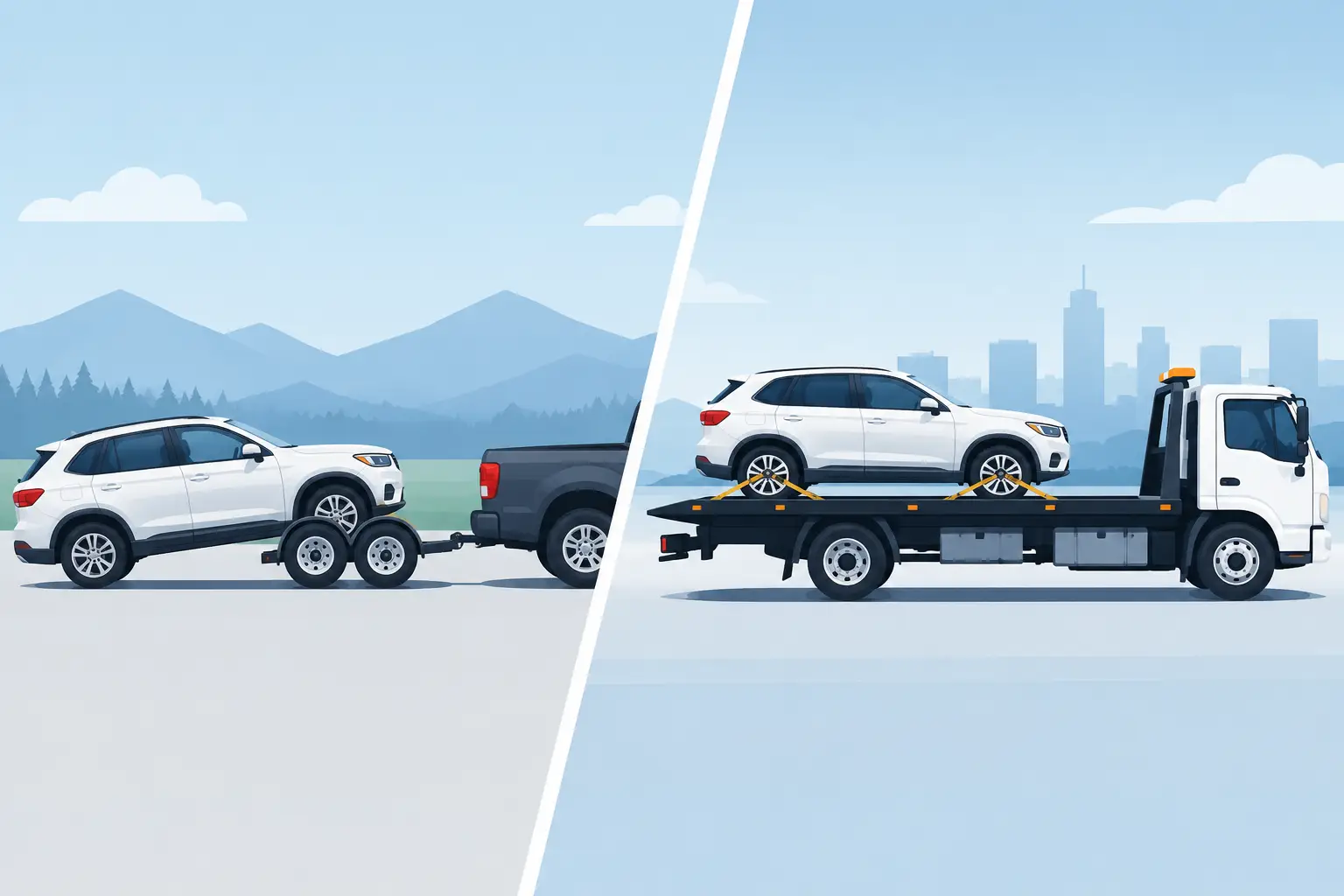
A breakdown on Loop 303, I-10, or US-60 leaves little room for guesswork. The choice between tow dolly versus flatbed transport affects your vehicle’s drivetrain, ground clearance, condition, and risk of additional damage. For some standard front-wheel-drive vehicles, a tow dolly can be an efficient option. For a damaged, luxury, classic, low-profile, or all-wheel-drive vehicle, a flatbed is often the safer call.
The right transport method is not about using the biggest truck for every job. It is about matching the equipment to the vehicle and the situation. A trained operator checks the drivetrain, whether the wheels roll, where the vehicle is located, and how far it needs to travel before loading begins.
Tow Dolly Versus Flatbed Transport: The Basic Difference
A tow dolly lifts two wheels off the ground, usually the front wheels of a front-wheel-drive vehicle. The other two wheels remain on the road while the vehicle is being towed. Dollies are useful when the vehicle rolls freely, has enough clearance, and is approved by its manufacturer for that type of towing.
A flatbed carries the entire vehicle with all four wheels off the pavement. The vehicle is loaded onto a level deck, secured at its designated tie-down points, and transported without its tires or drivetrain moving down the road. That makes a flatbed the preferred setup for many vehicles that need extra protection or cannot safely roll.
Neither method is automatically right in every situation. The vehicle’s owner manual, drivetrain layout, damage condition, and loading environment all matter.
Start With the Vehicle’s Drivetrain
Drivetrain is one of the first details a towing operator needs. Many front-wheel-drive cars can be towed with their front wheels on a dolly because the drive wheels are lifted. Even then, the vehicle must be properly secured, the rear tires must be in safe condition, and the steering wheel must be controlled according to the equipment and manufacturer requirements.
Rear-wheel-drive vehicles require more caution. Towing them with the drive wheels on the ground can turn internal drivetrain components without normal engine lubrication. In some cases, a driveshaft disconnect may be necessary. In others, flatbed transport is the straightforward, damage-conscious choice.
All-wheel-drive and four-wheel-drive vehicles are where assumptions can become expensive. Many of these vehicles should be transported with all four wheels off the ground unless the manufacturer specifically allows another method. A flatbed prevents unwanted drivetrain movement and removes the uncertainty of whether a transfer case, transmission, or differential could be damaged during the tow.
Electric vehicles also need individual attention. Their weight, tow points, parking systems, and manufacturer instructions can differ significantly by model. A professional operator verifies the approved recovery and loading procedure instead of treating an EV like a conventional sedan.
The Vehicle’s Condition Can Decide the Method
A car that starts, rolls, steers, and has four inflated tires is very different from one that has been in a collision or suffered a mechanical failure. A tow dolly depends on the vehicle being able to support part of the trip on its own rear wheels. If a wheel is damaged, a tire is flat, the suspension is broken, or the steering is locked, a dolly may not be appropriate.
Flatbeds are especially useful after collisions, curb strikes, engine failures, overheating events, and tire damage. They are also the better fit when a vehicle cannot be shifted into neutral, cannot be safely rolled, or has body damage that makes conventional loading risky. With a properly equipped truck, the vehicle can be winched onto the deck in a controlled manner rather than forced to roll where it should not.
For a vehicle sitting in a garage, parking space, ditch, or soft shoulder, access matters too. The operator may need to account for slope, room to maneuver, traffic exposure, and the vehicle’s position before selecting the safest recovery plan.
When a Tow Dolly Can Make Sense
A tow dolly can be a practical transport choice for a standard, operable front-wheel-drive vehicle that meets the equipment and manufacturer requirements. It can work well for certain local moves, mechanic-shop transports, and situations where the vehicle’s front end is disabled but the rear tires, suspension, and steering are sound.
It is not a shortcut for every vehicle. Low-profile cars may scrape while loading, and vehicles with unusually wide tires, body kits, damaged bumpers, or limited ground clearance may not fit or load safely. The vehicle also needs to be secured correctly at the tires and checked throughout the trip.
A reputable towing company will not choose a dolly simply because it is available. The operator should confirm the drivetrain and inspect the vehicle first. If there is any question about whether the vehicle can safely travel with two wheels on the ground, flatbed transport is usually the more conservative option.
Why Flatbed Transport Is Often the Safer Choice
Flatbed transport keeps all four tires off the road, which reduces exposure to drivetrain wear, tire failure, and rolling-related damage during the tow. It is the preferred method for many high-value vehicles, including classic cars, collector vehicles, luxury models, exotics, motorcycles, and lowered cars.
For low-clearance vehicles, the loading angle matters as much as the deck itself. An experienced operator can use the right approach, ramp setup, and winching technique to reduce the chance of bumper, splitter, rocker-panel, or undercarriage contact. The goal is not just to get the vehicle onto the truck. It is to load it without creating a second problem.
Securement also matters. Soft straps placed around the tires help protect wheels and avoid unnecessary contact with suspension components or delicate bodywork. This is particularly valuable when transporting custom wheels, restored classics, or vehicles whose owners know every inch of the paint and trim.
A flatbed is also the strong choice for longer trips across Metro Phoenix or beyond. High freeway speeds, Arizona heat, construction zones, and heavy traffic create enough variables without leaving two tires on the pavement. Carrying the vehicle fully on the deck provides greater control from pickup to delivery.
Arizona Roads Add Their Own Considerations
A vehicle that breaks down near Surprise, Peoria, Glendale, Sun City West, Waddell, or El Mirage may be sitting on hot pavement, a narrow shoulder, or a busy freeway ramp. Safety begins with getting the operator, customer, and vehicle out of traffic exposure as efficiently as possible.
The desert climate can also make tires, cooling systems, and batteries fail without much warning. If a vehicle overheated, lost a tire at highway speed, or stopped after a collision, its condition may not be obvious from a quick phone description. That is why a dispatcher may ask follow-up questions and send flatbed-capable equipment when the details point to a higher-risk load.
For off-road recoveries, ditch extractions, and vehicles stuck on uneven ground, the transport decision comes after the recovery itself. Once the vehicle is safely extracted, an operator still needs to determine whether it can roll and whether a flatbed is needed for the trip out.
What to Tell the Dispatcher Before a Tow
Clear details help send the right truck the first time. When requesting service, be ready to share:
- Your exact location, including a nearby cross street, freeway direction, or mile marker
- The year, make, model, and drivetrain if you know it
- Whether the vehicle starts, rolls, steers, and can be shifted into neutral
- Any damage, flat tires, low clearance, modified suspension, or wheel concerns
- The pickup and destination locations, plus whether the vehicle is in a garage, lot, ditch, or roadside shoulder
Mentioning that a vehicle is all-wheel drive, electric, classic, lowered, or recently involved in a collision can change the equipment decision immediately. Photos can also help when the vehicle has visible damage or difficult access, though a trained operator will make the final assessment on scene.
Choose Care Over Convenience
The fastest-looking option is not always the safest one. A tow dolly can be effective for the right front-wheel-drive vehicle in the right condition, but a flatbed provides the broadest protection when drivetrain compatibility, damage, clearance, or distance is a concern.
When the details are unclear, choose the transport method that protects the vehicle rather than gambling on a cheaper or quicker setup. Pride Transport & Towing can assess the situation, use appropriate securement, and get your vehicle where it needs to go with the care the situation demands.