A quiet road shoulder, a desert trail, or a loose patch near a worksite can turn into a stuck vehicle fast. When you need to recover vehicle from sandy terrain, the first few minutes matter. Spinning the tires, yanking on an improvised strap, or continuing to drive can bury the vehicle deeper and turn a manageable recovery into a more complicated winch-out.
Sand is common throughout the West Valley and Metro Phoenix area, especially around undeveloped lots, wash crossings, trail access points, and construction zones. The goal is not to force the vehicle out. It is to restore traction, protect the drivetrain and underbody, and use a controlled recovery method before damage occurs.
Start by Stopping the Wheel Spin
The moment the vehicle loses forward movement, ease off the accelerator. Tire spin throws loose sand behind the tires and creates deeper holes under the drive wheels. A few hard attempts can leave the differential, frame, or underbody resting on sand, with less tire contact than before.
Put the vehicle in park, set the parking brake if the ground is stable, and step out carefully. Soft sand can shift underfoot, so keep passengers away from the vehicle’s path and never stand directly in front of or behind a vehicle during a recovery attempt.
Look at the whole situation before choosing a fix. Check whether the vehicle is high-centered, whether one side has sunk farther than the other, and whether the sand is firm a few feet ahead or behind the vehicle. Also note the slope. A vehicle stuck on level ground may respond to basic traction work, while one angled toward a wash, embankment, fence, or roadway needs a more controlled approach.
Assess Whether a Self-Recovery Is Realistic
A light, two-wheel-drive vehicle with tires only slightly sunk may be able to move with careful preparation. A vehicle buried to the axle, high-centered, carrying a heavy load, or positioned on a slope is usually better handled with professional recovery equipment.
Before trying to move, clear packed sand from in front of and behind all drive tires. A shovel is ideal, but even a sturdy digging tool can create enough of a gradual ramp for the tires to climb. Avoid digging straight down beside the tires. You want a smooth exit path, not a deeper hole.
If the vehicle has a selectable drive mode, use the manufacturer’s recommended setting for loose surfaces. Engage four-wheel drive only as directed in the owner’s manual. For vehicles with traction control, some systems reduce power so aggressively that they prevent momentum in loose sand. Others are designed to work with the vehicle’s off-road settings. The correct choice depends on the vehicle, so do not guess.
Lowering tire pressure can increase the tire’s footprint and improve flotation on soft sand. But it is not a universal answer. Driving too far or too fast on underinflated tires can unseat a tire from the wheel, damage the sidewall, or create handling problems when you reach pavement. Only air down if you have a reliable way to reinflate the tires before returning to the road, and stay within the vehicle and tire manufacturer’s guidance.
Use Traction Tools Carefully
Traction boards, sand ladders, floor mats made for recovery, or other purpose-built traction aids can help when the vehicle is lightly stuck. Position them firmly under the drive tires in the intended direction of travel. Clear enough sand that the tire can climb onto the tool instead of pushing it deeper.
Use gentle throttle. The vehicle should crawl out, not launch. If the tires begin to spin again, stop immediately, reset the traction aid, and reassess. Repeated attempts often chew up the boards, bury them, or worsen the rut.
Do not use random objects that can shatter, slip, or become projectiles. Cardboard, branches, loose rocks, and household materials rarely provide dependable traction under a loaded tire. Rocks are particularly risky because they can puncture a tire, bend a wheel, or damage components beneath the vehicle.
Once the vehicle starts moving, continue slowly onto firmer ground. Do not stop until all four tires are on stable terrain. Then inspect the tires, wheel wells, underbody, and front or rear bumper area for packed sand or visible damage.
Never Pull From the Wrong Point
Improvised towing is where a simple sand recovery can become dangerous. A tow ball is not a recovery point. Neither are bumper covers, suspension parts, axle housings, or thin tie-down loops that were not designed for recovery loads. A strap or chain that breaks, or a component that tears free, can strike people or vehicles with severe force.
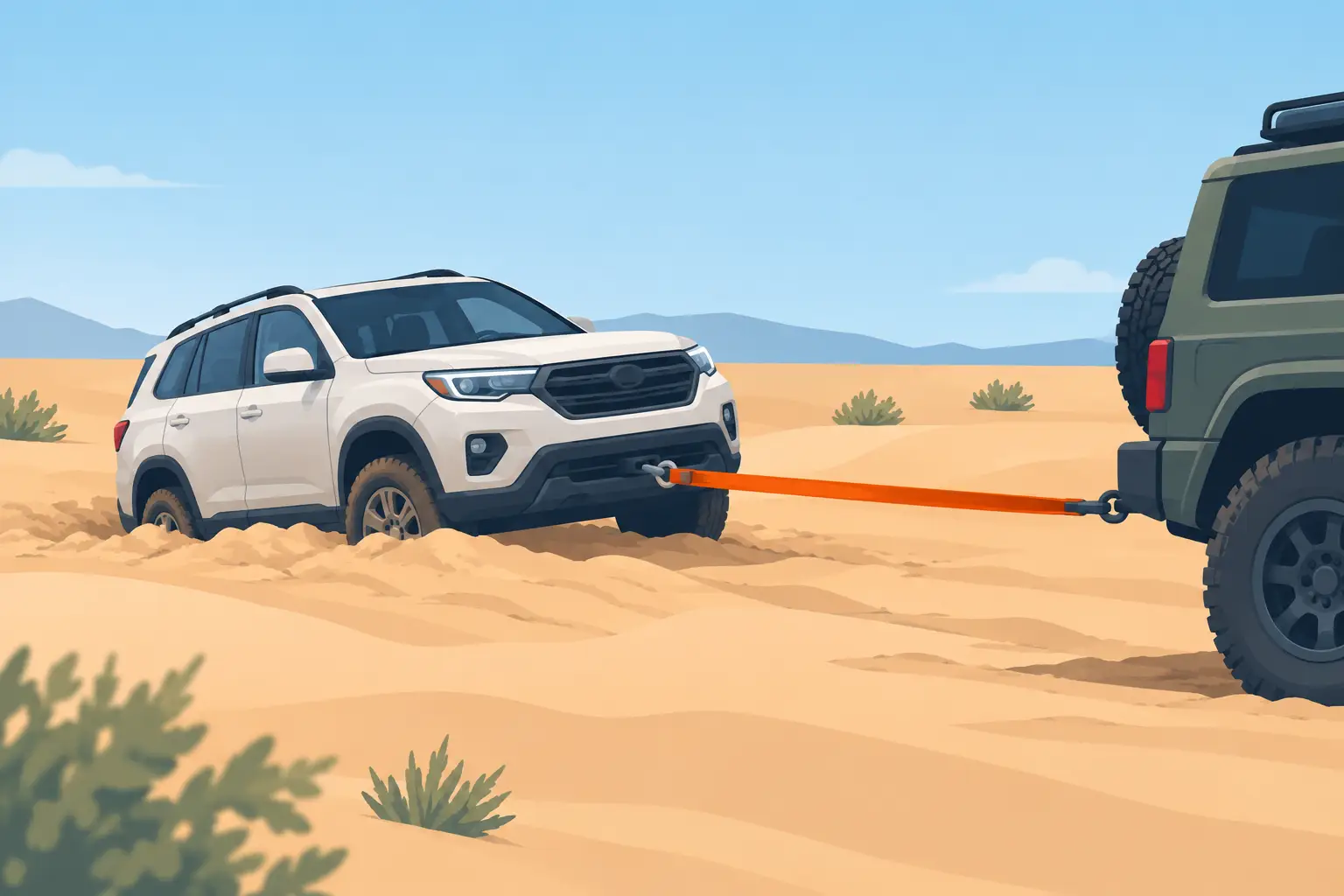
If another vehicle is available, both drivers need a clear plan, a rated recovery strap or rope, approved recovery points, and enough room to perform the pull without crossing traffic or placing anyone in the line of tension. The pulling vehicle should use steady, controlled force. High-speed jerks and aggressive momentum pulls dramatically increase the chance of equipment failure and vehicle damage.
This is also where vehicle value matters. Low-profile cars, classic vehicles, luxury models, and vehicles with sensitive aero panels can be damaged by incorrect attachment or a poor pull angle. The same is true for motorcycles, which should not be dragged or secured by handlebars, forks, or delicate trim.
When to Call for an Off-Road Winch-Out
Call for a professional winch-out when the vehicle is high-centered, sunk deeply, loaded heavily, blocked by terrain, or close to a hazard. It is also the right call if you do not have rated gear, cannot identify approved recovery points, or have already made several unsuccessful attempts.
A trained recovery operator evaluates the vehicle’s weight, direction of pull, ground conditions, attachment points, and the location of safe anchors before putting tension on the line. Depending on the situation, the recovery may involve a winch, recovery straps, snatch blocks, soft shackles, traction support, or a flatbed after the vehicle is brought to stable ground.
The right equipment protects more than the vehicle. It reduces risk to passengers, bystanders, and the operator. It can also prevent the costly damage that comes from pulling a vehicle sideways, dragging it across buried obstacles, or attaching to parts not built for the load.
Pride Transport & Towing provides 24/7 off-road winch-outs and vehicle recovery for drivers across Surprise, the West Valley, and the broader Phoenix area. A dispatcher can gather the details that affect the response, including your vehicle type, access conditions, how deeply it is stuck, and whether the location is near a major route, trail, wash, or worksite.
Help the Recovery Crew Reach You Safely
If cell service is available, share the most accurate location possible. A dropped map pin, nearby cross streets, trailhead name, gate number, mile marker, or visible landmark can save valuable time. Let the dispatcher know whether a standard tow truck can access the location or whether the route includes deep sand, narrow turns, low branches, soft shoulders, or locked access.
While waiting, keep people safely away from the tires and recovery area. In extreme Arizona heat, move into shade if possible, conserve water, and avoid leaving children or pets in a hot vehicle. At night, use hazard lights if they are visible to traffic, but do not stand in a travel lane or attempt a recovery near moving vehicles.
A sand recovery should end with the vehicle on firm ground, not simply moving a few feet. Stop early, use the right equipment, and ask for help before a stuck tire becomes damaged suspension, bodywork, or a dangerous roadside situation.