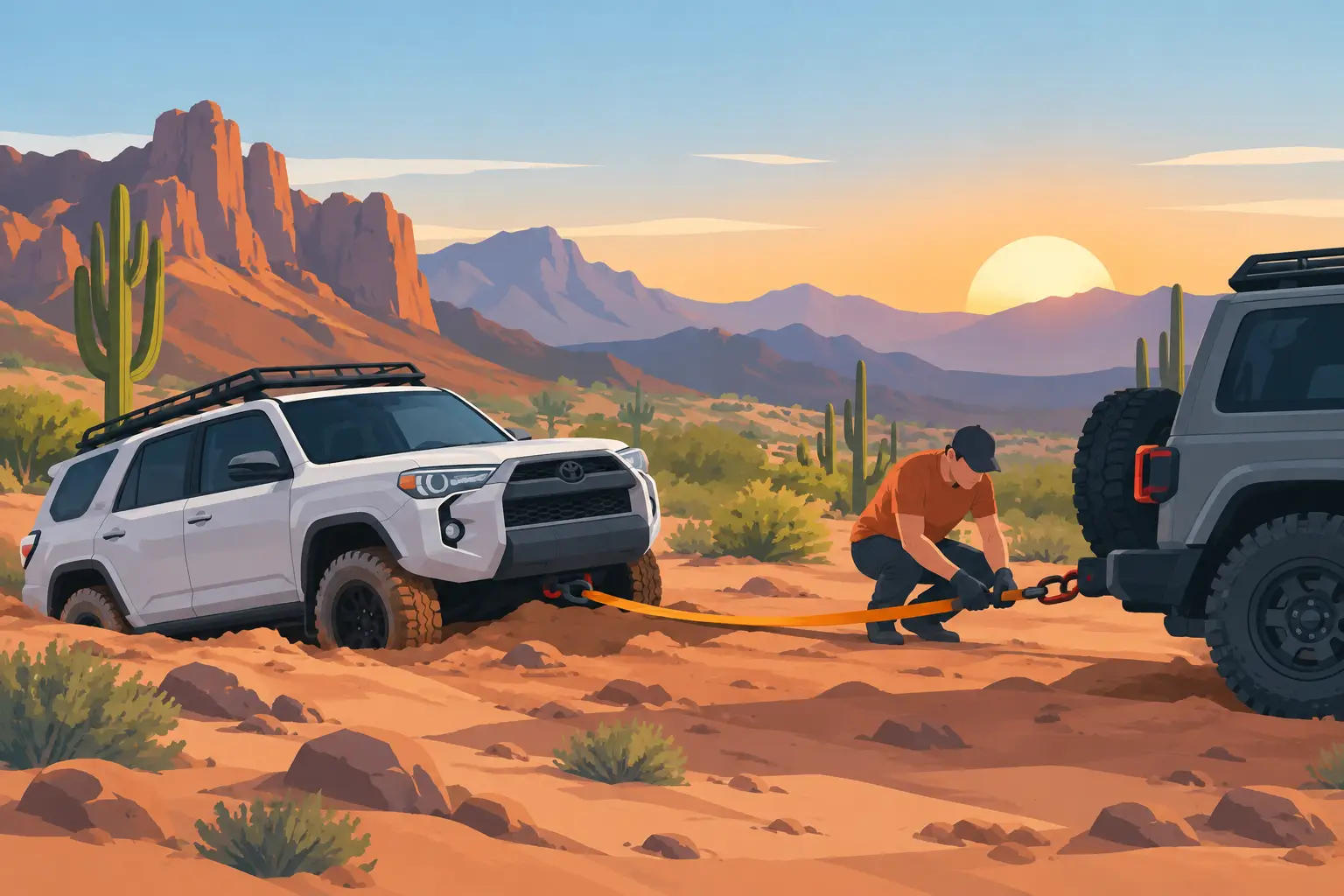
A desert trail can look firm one minute and swallow a tire the next. Loose sand, deep ruts, soft wash bottoms, hidden rocks, and sudden monsoon mud can turn a routine outing into a recovery situation fast. This off road recovery guide explains what to do first, what not to do, and when a professional winch-out is the safer call for drivers across Surprise, the West Valley, and Metro Phoenix.
Start With Safety, Not the Gas Pedal
When traction disappears, the natural reaction is to press the accelerator harder. That is often what turns a minor stuck situation into a buried vehicle. Spinning tires dig holes, throw loose material under the chassis, overheat components, and can leave your vehicle sitting on its frame or suspension.
Stop as soon as you recognize that forward progress is gone. Shift into park, set the parking brake if the surface allows, and step out carefully to inspect the area. Watch for unstable ground, traffic on narrow access roads, steep drop-offs, cactus, and the possibility of a wash filling with water. Never stand downhill from a vehicle on an incline, and keep passengers clear while you assess the recovery.
Arizona conditions deserve extra caution. A dry wash can become dangerous quickly during rain miles away from your location. If there is any threat of flash flooding, do not attempt a recovery in the wash. Move to higher ground if it is safe to do so and call for assistance.
Assess Why the Vehicle Is Stuck
A good recovery plan begins with the cause of the problem. Look at the tires, the underside of the vehicle, and the direction of travel. You may be dealing with loose sand, mud, a tire wedged against a rock, a high-centered vehicle, or a combination of all four.
If the tires are simply slipping in shallow sand or loose dirt and the vehicle is not high-centered, a controlled self-recovery may be possible. Clear loose material from in front of or behind the drive tires, depending on the direction you intend to travel. Straighten the wheels, choose the proper drive setting for your vehicle, and use gentle, steady throttle. Quick steering inputs and wheel spin usually make traction worse.
A vehicle that is resting on its frame, skid plates, differential, or suspension needs a different approach. More throttle will not lift it free. Trying to drag it over rocks without a proper recovery point can damage the undercarriage, steering, drivetrain, or bumper. This is the point where professional equipment and an experienced operator can prevent an expensive repair.
Check Recovery Points Before Connecting Anything
Not every metal part under a vehicle is a recovery point. Factory-rated recovery hooks, properly installed recovery points, and manufacturer-approved tow eyes are designed to take load when used correctly. Trailer hitch balls, suspension components, control arms, tie-down loops, and most bumpers are not safe attachment points for a hard pull.
A detached hitch ball or failed strap can become a serious projectile. Do not guess. If you cannot identify a rated recovery point, do not connect a rope, chain, or winch line to the vehicle. A professional recovery operator can inspect the vehicle, select a safe attachment method, and control the pull from a stable position.
How to Attempt a Simple Self-Recovery
Self-recovery is only reasonable when the vehicle is stable, the terrain is mild, you have clear access, and there is no risk to people nearby. It also depends on having the right equipment. A shovel, traction boards, a tire pressure gauge, an air compressor, gloves, and rated recovery gear can make a meaningful difference.
Start by clearing packed sand, mud, or rocks around the drive tires. Build a gradual path rather than a steep ledge directly in front of the tire. Place traction boards squarely in the direction of travel, keeping hands and feet out of the path of the tires. Then use slow throttle and maintain momentum only as needed.
Lowering tire pressure can increase the contact patch and help in soft sand, but it is not a universal fix. The correct pressure depends on the tire, vehicle weight, terrain, and wheel setup. Reduce pressure conservatively, avoid sharp turns that could unseat a tire, and reinflate before returning to pavement. If you do not have a reliable way to air back up, it is better not to air down aggressively.
Avoid using a chain for a snatch recovery. Chains do not stretch, can fail violently, and can damage vehicles. Kinetic recovery ropes also require training, appropriate rated points, enough open space, and a vehicle capable of making a controlled pull. A rushed recovery between two unprepared drivers can injure someone or damage both vehicles.
When to Stop Trying and Call for Recovery
There is no prize for making a stuck vehicle worse. Call for an off-road winch-out when the vehicle is high-centered, leaning, trapped in deep sand or mud, stuck near a drop-off, or unable to move without repeated wheel spin. The same applies if you are alone, lack proper rated equipment, cannot identify safe recovery points, or are dealing with a luxury, classic, exotic, low-profile, or heavily modified vehicle.
Professional recovery matters even more when the vehicle has limited ground clearance or expensive bodywork. An improper pull can crack a bumper, bend an air dam, damage exhaust components, or place stress on suspension parts. Controlled winching uses the right angles, anchor points, rigging, and line management to bring the vehicle out with as little additional damage as possible.
Pride Transport & Towing provides 24/7 off-road winch-outs and vehicle recovery for drivers who get stuck in sand, washes, ditches, dirt access roads, and desert terrain around the West Valley. Dispatchers can help gather the details an operator needs before heading out, including your vehicle type, location, terrain, and whether the vehicle is upright and accessible.
Information That Speeds Up a Winch-Out
Your location is the most important detail. A trail name is helpful, but a dropped map pin, GPS coordinates, cross streets, mile marker, gate number, or clear landmark can save valuable time. Desert access roads can be confusing after dark, so tell dispatch whether your vehicle is on a maintained road, inside a trail system, behind a gate, or down a narrow path.
Describe the vehicle honestly. Mention whether it is two-wheel drive, all-wheel drive, four-wheel drive, lifted, lowered, towing a trailer, or loaded with equipment. Let the dispatcher know if it is sitting on the frame, has a flat tire, has visible damage, or is facing uphill or downhill. Accurate details help send equipment suited to the recovery instead of creating delays at the scene.
While waiting, stay with the vehicle if conditions are safe. Keep lights on after dark, conserve phone battery, and remain visible without standing in the recovery path. Move pets and passengers to a safe area before recovery begins, then follow the operator’s instructions. Recovery zones need room for winch lines, straps, vehicles, and changing terrain.
Avoid Getting Stuck on the Next Trip
Preparation is less exciting than a recovery story, but it keeps a small problem from becoming an all-night ordeal. Check weather conditions before entering desert trails, especially during monsoon season. Tell someone where you are going and when you expect to return. Carry water, charged communications, a first-aid kit, basic tools, and recovery equipment appropriate for your vehicle and skill level.
Know the limits of your vehicle, too. All-wheel drive can help with traction but does not create ground clearance. Four-wheel drive can still get high-centered. Street tires may struggle in loose sand, and low-profile vehicles can be damaged by terrain that looks harmless from the driver’s seat. Turn around early when the trail no longer matches your vehicle, equipment, or experience.
The best recovery decision is often made before you touch the throttle again: stop, inspect the situation, protect the people around you, and get qualified help when the terrain or the vehicle calls for it.