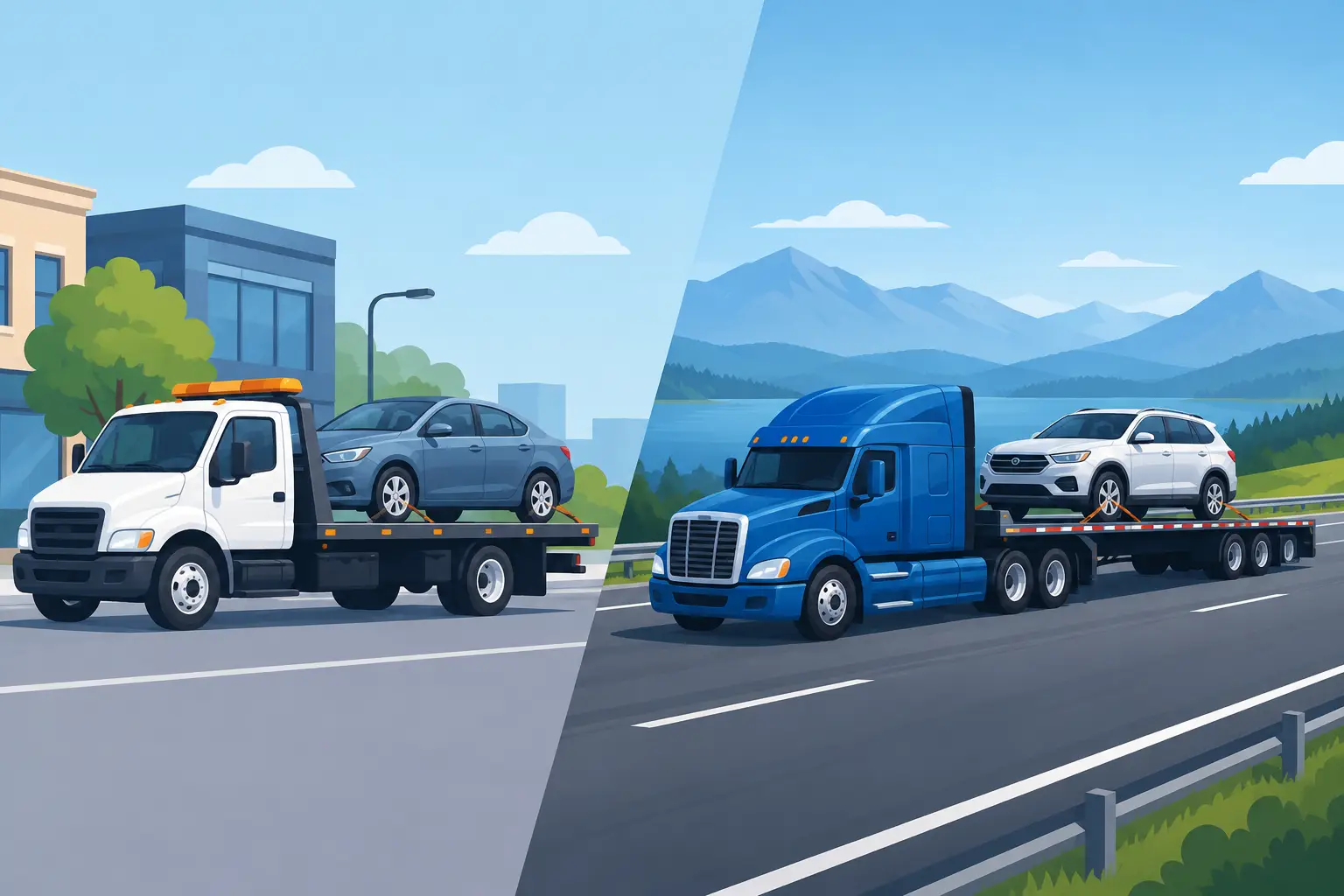
A breakdown on Loop 303 can feel very different from a planned move from Surprise to another Arizona city, but both begin with the same question: what kind of tow do you need? Understanding local versus long distance towing helps you request the right equipment, plan for the trip, and protect your vehicle from unnecessary handling.
The shortest trip is not always the simplest one. A local tow may be urgent and require traffic-safe recovery from a freeway shoulder. A longer tow may be scheduled, but it calls for more planning around route, securement, loading, and delivery. The right choice depends on where your vehicle is, where it needs to go, its condition, and how much care it requires.
Local Versus Long Distance Towing: The Practical Difference
Local towing generally covers a vehicle move within the immediate service area. For West Valley drivers, that may mean towing from a home in Surprise to a repair shop in Peoria, moving a disabled vehicle off I-10, or taking a car from Sun City West to a nearby dealership. These calls are often time-sensitive. The priority is getting the vehicle out of an unsafe location and to a suitable destination quickly.
Long distance towing involves transport beyond the normal local area, often between cities, across the greater Phoenix region, or to another part of Arizona. The distance itself matters, but so does the operating plan. A tow from Glendale to a specialist shop in Mesa, for example, needs more fuel, more drive time, and a route that keeps the vehicle secure for the full trip.
There is no single mileage line that applies to every towing company. Instead of focusing only on miles, explain your pickup point, destination, vehicle type, and whether the vehicle rolls, steers, and brakes normally. That information lets a dispatcher match the job with the correct truck and give you realistic expectations.
When Local Towing Is the Right Call
Local towing is usually the best fit when a vehicle has broken down near home, work, a shop, or a safe storage location. A dead battery that will not hold a charge, a flat tire without a usable spare, overheating, collision damage, or an engine issue can all turn into a local tow request.
On busy routes such as US-60, I-17, I-10, or Loop 303, local towing is about more than convenience. Getting a disabled vehicle out of traffic reduces risk for the driver, passengers, and other motorists. An experienced operator assesses the shoulder, traffic flow, vehicle position, and safest loading method before moving the vehicle.
A local tow also makes sense when the repair decision is straightforward. If you already have a trusted mechanic nearby, taking the vehicle directly there can prevent a second move later. If the shop is closed, a secure drop-off or transport home may be the better option until repairs can be arranged.
Local does not mean basic handling
Even a short tow deserves the right loading process. Low-clearance cars, motorcycles, classic vehicles, luxury models, and vehicles with collision damage should not be treated like routine pickups. A few miles of improper loading can scrape a bumper, stress a drivetrain, or create damage that was not there before.
Flatbed-capable equipment is often the preferred choice for all-wheel-drive vehicles, low-profile cars, non-running vehicles, and high-value vehicles. Soft straps and careful securement help protect wheels, suspension components, and bodywork. The trip may be local, but the standard of care should remain high.
What Changes With Long Distance Towing
Long distance towing is best when the vehicle needs to reach a specific destination that is not close by. You may be transporting a classic car to a restoration shop, moving a motorcycle to a buyer, taking a disabled vehicle back to your home city, or hauling light equipment to a job site. In these cases, getting the vehicle to the nearest shop may not solve the actual problem.
A longer trip adds planning considerations. The operator needs to account for route conditions, elevation changes, construction, travel time, securement checks, and the condition of the vehicle or equipment being moved. If the vehicle is inoperable, damaged, or missing wheels, disclose that early. It may affect the equipment needed to load it safely.
Long distance transport is also common for specialty vehicles. A collector vehicle may need to go to a marque-specific repair shop. An exotic car may require a loading angle that avoids front-end damage. A motorcycle needs proper tie-down points and balanced securement. The goal is not simply to get it there. The goal is to get it there in the same condition it was loaded.
Scheduled transport versus emergency transport
Many long distance towing jobs can be scheduled, which gives you time to prepare the vehicle and confirm delivery details. Scheduled transport works well for planned repairs, private sales, relocations, auction pickups, equipment moves, and non-urgent shop transfers.
Emergency long distance towing is different. If you are stranded outside the West Valley and need to get home, or if a vehicle breaks down far from your preferred repair facility, the dispatch process needs to move quickly. Provide your exact location, direction of travel, vehicle description, destination, and any safety concerns. If you are on a freeway shoulder, stay safely away from traffic when possible and follow dispatcher instructions.
Cost Factors to Expect
Towing cost is influenced by more than local or long distance mileage. The pickup environment, vehicle condition, loading difficulty, destination, time of day, and equipment required all affect the job. A straightforward local tow from a parking lot is not the same as recovering a disabled SUV from a ditch, and neither is the same as transporting a low-clearance vehicle across the state.
For long distance towing, distance and drive time play a larger role. Route restrictions, fuel use, tolls where applicable, wait time, and specialized equipment can also be part of the quote. The most useful way to avoid surprises is to give complete information from the start rather than estimating or leaving out details about damage, keys, wheel condition, or access problems.
If you are choosing between towing a vehicle home, to a nearby shop, or to a preferred specialist farther away, consider the total cost of the repair process. A cheaper short tow can become more expensive if the vehicle has to be moved again. On the other hand, a local shop may be the practical choice when the repair is simple and the vehicle cannot safely travel farther.
Choosing the Right Tow for Your Vehicle
Your vehicle type should guide the towing method. Front-wheel-drive, rear-wheel-drive, all-wheel-drive, electric, hybrid, lowered, classic, and damaged vehicles can each have different transport requirements. A vehicle that cannot roll or steer normally needs a different approach than one with a simple mechanical failure.
For collector, luxury, exotic, or low-profile vehicles, ask how the vehicle will be loaded and secured. Flatbed transport and soft-strap practices are especially valuable when protecting wheels, bodywork, and low front ends. Do not assume a short move eliminates these concerns.
Motorcycles deserve the same attention. Proper motorcycle towing involves stable loading, appropriate wheel restraint, and secure tie-down placement. Light equipment such as skid steers, forklifts, tractors, toolboxes, sheds, and containers also requires a clear description of dimensions, weight, and loading access before transport is scheduled.
Information That Speeds Up Dispatch
Whether you need local help or a longer transport, a clear call helps get the right truck moving. Have your vehicle year, make, model, color, exact location, destination, and condition ready. Mention whether you have keys, whether the tires hold air, whether the vehicle starts, and whether it is blocked in or off the pavement.
If you are on a freeway or unfamiliar road, use mile markers, cross streets, nearby exits, or a live location from your phone. Let the dispatcher know if you are in a hazardous position, carrying passengers, or dealing with a collision. Those details help prioritize the response and prepare the operator for the scene.
Pride Transport & Towing provides 24/7 dispatch for urgent roadside situations as well as planned local and long-distance vehicle and equipment moves across the West Valley and Metro Phoenix corridor. The right tow begins with an accurate description, then a careful plan to get your vehicle where it needs to be.
When your vehicle cannot safely continue, do not let distance alone decide the destination. Choose the repair shop, home, storage location, or specialist that makes the most sense for the vehicle and the situation, then make sure the trip there is handled with the care it deserves.