A dead battery on Loop 303, a flat tire on US-60, or an overheating engine on I-10 can turn into a safety issue in minutes. Knowing how to safely wait roadside gives you a better chance of avoiding a second incident while help is on the way. The goal is simple: get yourself out of traffic exposure, make your vehicle easy to see, and avoid turning a mechanical problem into a personal emergency.
Get to the safest available location first
If the vehicle is still moving, do not stop abruptly unless the car is unsafe to operate. Turn on your hazard lights, ease off the accelerator, and move toward the right shoulder, an exit, a parking lot, or a side street. A parking lot is always preferable to a freeway shoulder. On city streets, look for a wide shoulder, a driveway, or a low-traffic side road where you can get fully out of the travel lane.
On Arizona freeways, the right shoulder is usually the best immediate choice. Pull as far right as the surface safely allows, but avoid soft dirt, steep drop-offs, deep drainage areas, or spots where the vehicle could sink. Straighten the wheels, set the parking brake, and put the transmission in Park.
Your vehicle may not make it to a safe spot. A sudden tire failure, smoke, loss of steering, or a collision can limit your options. In that case, prioritize getting out of the active lane, even if you can only reach the shoulder. Keep the hazard lights on and call for help as soon as you are stopped.
Decide whether to stay in the vehicle or get out
There is no single answer for every roadside breakdown. Staying in the vehicle can protect you from passing traffic, heat, dust, and unsafe footing. But a vehicle stopped close to high-speed traffic may be at risk of being struck. The safest choice depends on where you are parked, how much shoulder is available, and whether you have a protected place to stand.
If your vehicle is well off the roadway, on a wide shoulder, or in a parking area, staying inside with your seat belt on is often the best option. Keep the doors locked and do not sit with your back toward traffic near an open door.
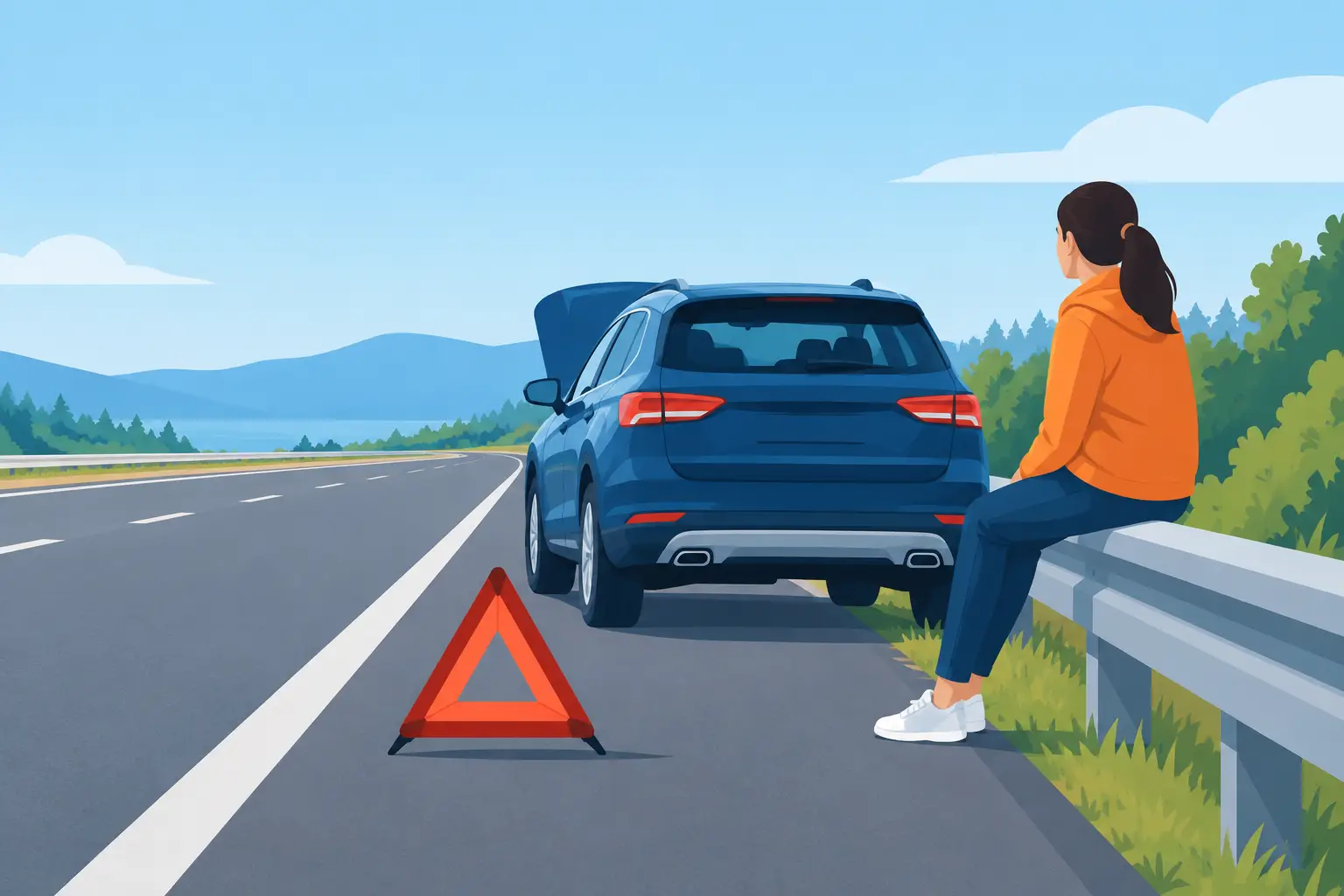
If your vehicle is disabled in or very close to a travel lane, or if it is smoking, leaking fuel, or has been involved in a serious collision, get out only when you can do so safely. Exit from the side away from traffic whenever possible. Move behind a guardrail if one is available, then stay well away from the vehicle and out of the path of approaching traffic.
Never stand directly in front of or behind a disabled vehicle on a freeway shoulder. If another driver loses control, those are dangerous impact zones. Avoid waiting in a ditch, wash, or drainage channel too. Flash flooding can develop quickly during monsoon weather, even when rain is falling miles away.
Be especially careful with children, pets, and passengers
Keep everyone together and away from traffic. Children should remain secured in the vehicle unless there is an immediate reason to evacuate. Do not allow anyone to wander along the shoulder, cross freeway lanes, or attempt to flag down traffic.
Pets add another complication. A frightened dog can pull free, run into traffic, or cause you to step into danger while trying to catch it. Keep pets leashed or contained. If you must leave the vehicle because of fire, smoke, or an unsafe position, move everyone to the safest protected area available before dealing with belongings or vehicle damage.
Make your vehicle visible without putting yourself at risk
Hazard lights should be on the moment you recognize a problem. At night, during dust storms, or in heavy rain, visibility matters even more. If your car still has power, leave the headlights on when it is dark, but monitor the battery if you are waiting a long time for a jump start.
Reflective triangles, flares, or LED roadside beacons can help, but only use them if you can place them without walking into traffic. On a busy freeway, especially after dark, it is usually safer to stay protected than to walk down the shoulder setting out warning devices. Your hazard lights and a clear location for the responding operator are more valuable than taking unnecessary risks.
Do not rely on standing outside and waving at cars. Drivers may not see you soon enough, and sudden lane changes can create another crash. Your priority is to be visible from inside a safe location, not to become visible by standing closer to traffic.
Call for help and give a location that dispatch can use
Once you are in the safest position available, call for roadside assistance, towing, or emergency services as needed. If there are injuries, fire, a vehicle blocking travel lanes, or an immediate threat, call 911 first.
For a tow truck or roadside technician, give clear details about your location and vehicle condition. “I am on I-10” is not enough for a fast response. Share your direction of travel, nearest exit, mile marker, cross street, visible business, or landmark. On Loop 303, I-17, US-60, and other high-speed routes around the West Valley, knowing which side of the freeway you are on can prevent a delayed arrival.
Describe the problem accurately. Let dispatch know whether you need a jump start, lockout service, tire change, fuel delivery, winch-out, or tow. Mention if the vehicle is low-profile, all-wheel drive, a motorcycle, a classic car, or a luxury vehicle that needs careful loading. A properly equipped operator can arrive ready to handle the job without improvising at the roadside.
If you are waiting for Pride Transport & Towing or another service provider, ask for an estimated arrival window and the truck description if one is available. Keep your phone nearby, with the ringer on, so the operator can reach you if they need to confirm your position.
Protect yourself from Arizona heat while you wait
Roadside waits in Surprise, Peoria, Glendale, and across Metro Phoenix are different in summer. A breakdown that would be inconvenient in mild weather can become dangerous when pavement temperatures soar and the cab begins heating up.
If the vehicle can run safely and there is no overheating, smoke, or fuel smell, air conditioning may help protect passengers from heat. If the engine has overheated, shut it down. Do not open a hot radiator cap, and do not pour cold water into a hot engine. That can cause serious burns and further vehicle damage.
Drink water in small amounts while you wait, especially if you have been outside. If you feel dizzy, weak, confused, nauseated, or unusually sweaty, treat it as a heat-related warning sign and seek emergency assistance. Shade from an overpass or nearby building can help, but never cross active freeway lanes to reach it.
A basic vehicle emergency kit is worthwhile in Arizona. Keep water, a phone charger, a flashlight, reflective gear, basic first-aid supplies, and a sun hat or light cover in the vehicle. These items will not replace professional help, but they can make a short roadside wait much safer.
Do not attempt a risky roadside repair
Some drivers can safely change a tire in a parking lot or quiet residential area. A freeway shoulder is different. Fast-moving traffic, uneven ground, limited visibility, and distracted drivers create a serious risk when you are kneeling beside a vehicle or working near the wheel line.
If you are not fully separated from traffic, wait for a professional. The same applies to crawling under a vehicle, checking wiring near a hot engine, or trying to push a stalled vehicle through traffic. A quick repair is not worth the exposure.
Be cautious with help from strangers as well. Many people mean well, but you do not need to accept a ride, unlock your vehicle, or hand over keys to an unknown person. Keep your doors locked, communicate through a partially opened window if needed, and wait for the service provider you contacted. Verify the responding truck and operator before releasing your vehicle.
What to do when the tow truck arrives
When the operator arrives, remain in the safe place you selected until they signal that it is safe to approach. A trained tow operator will evaluate traffic, vehicle position, shoulder width, and loading needs before beginning work. Let them control the recovery area rather than walking around the truck or standing near cables, ramps, and winch lines.
Tell the operator about any special vehicle concerns before loading starts. Low ground clearance, all-wheel drive systems, locked wheels, air suspension, collector-car finishes, and motorcycle tie-down points all affect the safest method of transport. For specialty vehicles, flatbed loading and soft-strap securement may be the right choice to protect the vehicle from unnecessary damage.
Roadside trouble is stressful, but the safest response is rarely complicated: move out of danger if you can, stay visible, keep clear of traffic, and wait in the safest available place. A calm decision in the first few minutes can protect you, your passengers, and your vehicle until qualified help arrives.