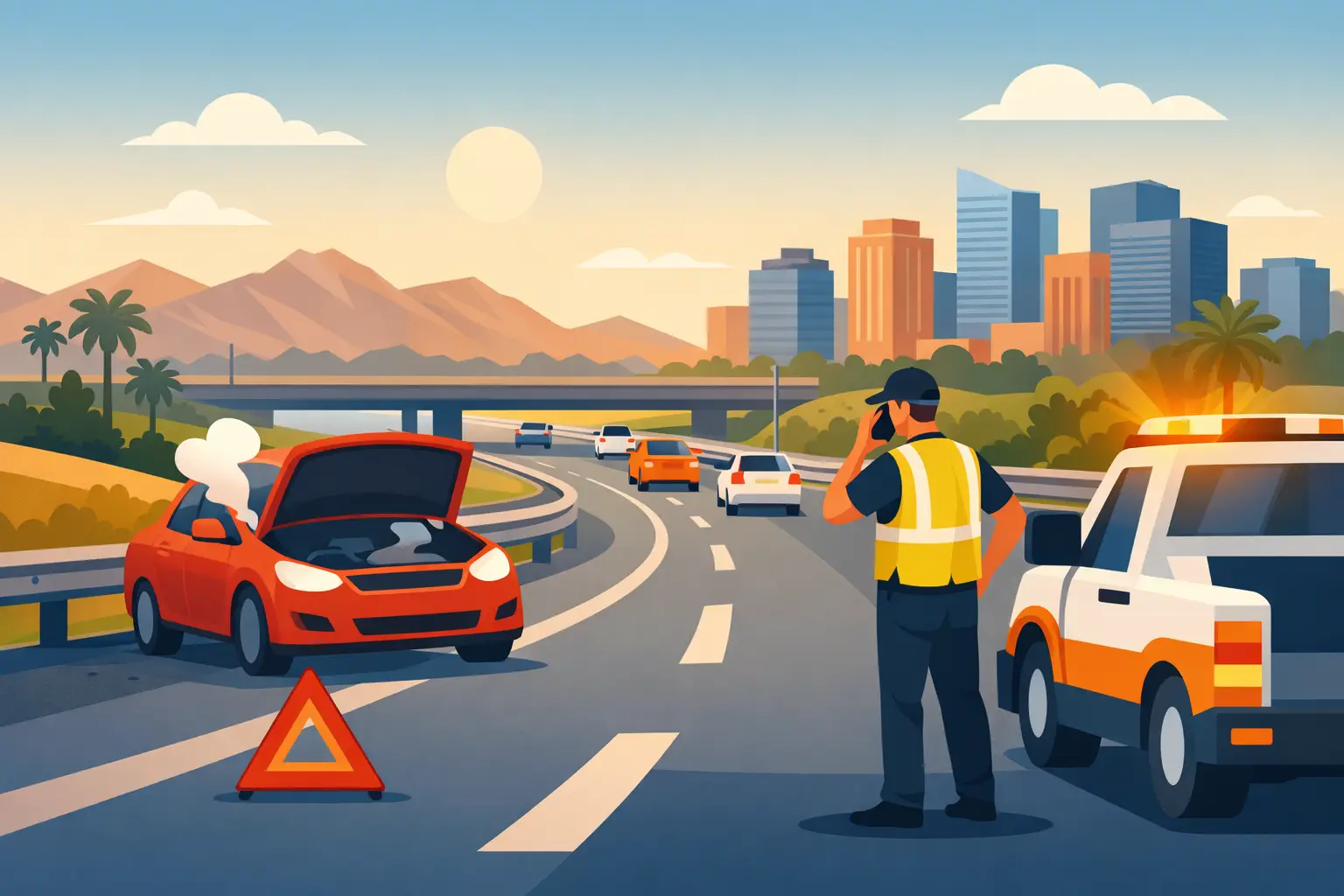
A flat tire on Loop 303 feels different from a flat tire in a parking lot. Traffic is moving fast, shoulders can disappear near ramps and construction zones, and Arizona heat can turn a short wait into a safety concern. This freeway breakdown safety guide is built for drivers on I-10, US-60, I-17, Loop 303, and other West Valley routes who need to make smart decisions before help arrives.
The first goal is not diagnosing the vehicle. It is getting yourself out of the path of traffic. A damaged tire, overheating engine, dead battery, or warning light can be handled later. On a freeway, your position and visibility are what matter most in the first few minutes.
Freeway Breakdown Safety Guide: The First Five Minutes
If the vehicle is still moving, keep a steady grip on the wheel and ease off the accelerator. Do not brake hard unless you must avoid a hazard. Turn on your hazard lights right away, then look for the safest available place to stop. An exit ramp, a wide shoulder, a frontage road, or a parking area is generally better than stopping alongside through lanes.
If you have enough control to reach an exit without putting others at risk, take it. But do not force a vehicle with a severely flat tire, steering problem, smoke, or an overheating engine to travel farther than it safely can. Driving on a destroyed tire can damage the wheel, suspension, and bodywork. Continuing with an overheating engine can turn a repairable issue into major engine damage.
Once you are stopped, do these things in order:
- Turn on hazard lights and keep them on.
- Set the parking brake and place the vehicle in park.
- Keep your seat belt fastened while you assess traffic conditions.
- Call for assistance and give the dispatcher your direction of travel, nearest exit, cross street, mile marker, or recognizable landmark.
- If the vehicle is in a travel lane, on a narrow shoulder, or in another immediately dangerous position, call 911 first.
Avoid standing outside the vehicle while traffic is passing close by. If you are safely off the roadway with room beyond the shoulder and traffic conditions allow, exit through the passenger-side door. Move well away from the roadway, preferably behind a guardrail. If there is no safe place to stand outside, remain buckled inside the vehicle with the doors locked and wait for professional direction.
Choose the Safest Place to Wait
There is no single rule that fits every breakdown. A wide, clear shoulder in daylight is different from a blind curve at night, a construction zone, or a stopped vehicle partly blocking a lane. Use the conditions in front of you.
Staying inside is often the better choice when traffic is heavy, the shoulder is narrow, visibility is poor, or you cannot reach a protected area without walking near moving vehicles. Keep the doors locked, windows mostly up, and hazard lights activated. If you need fresh air during extreme heat, use the vehicle’s ventilation only if it is safe to run the engine and there are no signs of smoke, fire, or a fuel leak.
Getting out can be safer when the vehicle is fully off the road and there is a barrier or open area far from traffic. Never stand directly in front of or behind the vehicle. A distracted driver can drift onto the shoulder with little warning, and a rear-end collision can push your vehicle forward.
Do not sit in the shade beneath an overpass if it requires crossing lanes or walking along the shoulder. In the Phoenix area, heat exposure is serious, but freeway traffic is an immediate danger. Call for help, describe your situation, and conserve water while you wait in the safest available position.
Do Not Attempt Roadside Repairs on the Freeway
Changing a tire on a residential street is one thing. Changing one a few feet from 70 mph traffic is another. Even if you have the jack, spare, and experience, a freeway shoulder may not provide enough room to work safely. Soft pavement, uneven ground, passing truck air pressure, and limited visibility all make roadside repairs riskier.
The same goes for checking under the hood. Steam, smoke, or a hot cooling system can cause serious burns. Do not remove a radiator cap from an overheated engine. If you smell fuel, see leaking fluid, or notice smoke, move away from the vehicle when it is safe to do so and notify emergency services.
A trained roadside operator can assess whether a tire change, jump start, lockout service, or tow is the safe solution. For a disabled vehicle on a busy freeway, the right equipment and traffic awareness matter as much as the repair itself.
Make It Easy for Help to Find You
A vague location can add unnecessary time to an already stressful situation. “I am on the 303” is a start, but a dispatcher needs details that identify where you are and which side of the freeway you are on.
Share the freeway name, direction of travel, nearest exit, mile marker, and vehicle description. Note whether you are on the main freeway, an on-ramp, off-ramp, HOV lane, frontage road, or shoulder. A white SUV northbound near Bell Road is far more useful than a white SUV on the freeway. If your phone map is working, use the displayed location to confirm the cross streets or exit number, but do not stand outside or walk around to improve your signal.
Tell the dispatcher about hazards as well. Mention if the vehicle is partially in a lane, if a tire is shredded, if the vehicle is low-profile, if it is a motorcycle, or if there has been a collision. A collector car, exotic vehicle, or lowered vehicle may require flatbed transport and soft-strap securement rather than a standard hookup. Giving that information up front helps the right truck arrive prepared.
If your battery is low, reduce unnecessary phone use after the call. Keep the phone available for return calls from the dispatcher or operator. A car charger, power bank, and written emergency contact number are worth keeping in the glove box.
Be Visible Without Creating More Risk
Hazard lights are your first warning to other drivers. At night, during dust storms, or in heavy rain, visibility becomes even more critical. If you have reflective triangles or a roadside beacon, use them only when you can place them without walking into the traffic path. They are not worth an injury.
Flares are not appropriate around fuel leaks, dry brush, or any situation involving fire risk. On Arizona roads, conditions can be especially dry for much of the year. Reflective gear and battery-powered warning lights are safer options for most drivers.
Keep interior lights low at night so you can see traffic outside. If another motorist stops to offer help, you do not need to open the door or accept a ride. A simple response through a closed window is enough: help is already on the way. Trust your judgment, particularly when you are alone or in an isolated location.
What to Keep in Your Vehicle
Freeway emergencies are less stressful when basic supplies are already in the vehicle. A compact kit should include drinking water, a charged power bank, flashlight, reflective vest, basic first-aid supplies, and a blanket or sun cover. Add a phone charging cable, emergency contact information, and any special medication you may need during an extended wait.
A spare tire and jack are still useful, but inspect them occasionally. Many newer vehicles have inflator kits instead of a full spare, and those kits are not a solution for every puncture or sidewall failure. Know what your vehicle carries before you need it. If you drive a specialty, luxury, classic, or low-clearance vehicle, keep the transport instructions available so the recovery operator can protect it from the first loading step.
When a Tow Is the Safer Call
A tow is the right choice when the car cannot move safely, has collision damage, overheats, has a serious tire failure, leaks fluids, or shows steering and braking problems. It is also the prudent choice when the vehicle is stranded in a location where roadside service would expose you or the operator to unnecessary traffic risk.
For West Valley drivers, Pride Transport & Towing provides 24/7 dispatch for emergency towing and roadside situations, with equipment suited to everyday vehicles as well as motorcycles, low-profile cars, and high-value vehicles requiring careful flatbed handling. When you call, be ready with your location, vehicle details, and a short description of the problem so the response can be matched to the situation.
A freeway breakdown is unsettling, but you do not have to solve it on the shoulder. Put distance between yourself and traffic, make your location clear, and let properly equipped help handle the vehicle when conditions are unsafe.