A stranded exotic car on Loop 303 is not a routine tow call with a more expensive badge. An exotic towing case may involve inches of ground clearance, a carbon-fiber splitter, wide tires, an electronically controlled parking brake, and an owner who has every reason to be concerned about how the vehicle moves next. The job is to solve the immediate problem without creating a second one.
For owners across Surprise, Peoria, Glendale, and the West Valley, the right response starts with a calm dispatcher, accurate details, and equipment that fits the vehicle. Whether the issue is a dead battery, a flat tire, mechanical failure, or a post-collision recovery, handling matters from the first call through final unloading.
Why an exotic towing case is different
Low-profile luxury and performance vehicles are designed for the road, not for improvised loading angles. A conventional tow method or poorly positioned ramp can scrape a front valance, damage an undertray, or put force on components that were never meant to carry a recovery load. The vehicle may also have limited tow-hook access, low-mounted suspension parts, and tires too wide for equipment that is not properly sized.
That is why the first question is not simply, “Where does it need to go?” It is, “What does the vehicle need to be moved safely?” A capable operator gathers the make, model, condition, drive configuration, clearance concerns, location, and destination before arriving. If the vehicle will not roll, is locked in park, or has collision damage, those details change the loading plan.
Arizona adds its own variables. Heat can turn a roadside shoulder into a difficult working environment. Fast-moving traffic on I-10, US-60, I-17, and Loop 303 leaves little room for hesitation. A careful tow still needs to be efficient, especially when the vehicle is stopped in an exposed lane or on a narrow shoulder.
The equipment and process that protect the vehicle
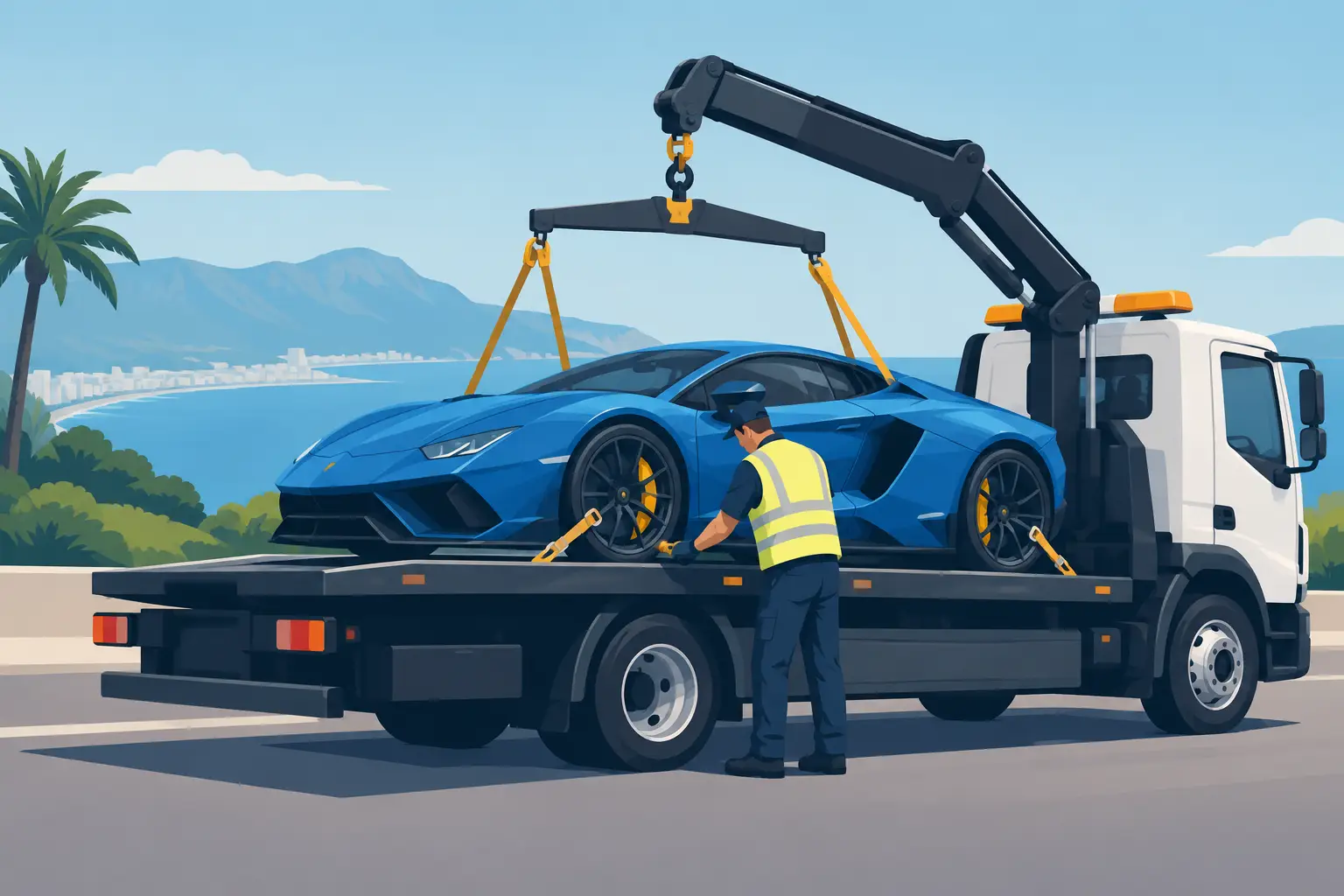
Flatbed-capable towing is often the preferred approach for an exotic vehicle because all four wheels can remain off the ground during transport. That reduces drivetrain concerns and avoids the risks associated with dragging, lifting from the wrong point, or relying on a setup that does not match the vehicle.
Loading angle is one of the most important details. A low car needs a gradual path onto the deck. Depending on its clearance and location, an operator may need to adjust the bed position, use appropriate ramp support, and take the loading process slowly. Rushing this stage is where preventable damage happens.
Securement matters just as much after the vehicle is on the bed. Wheel-based soft straps are designed to secure the vehicle without placing chains or metal hooks against delicate wheels, suspension components, or bodywork. The goal is stable transport with protection at the contact points. Pride Transport & Towing uses soft-strap handling and flatbed-capable equipment for specialty vehicles because a high-value vehicle deserves more than a one-size-fits-all approach.
Before moving, the operator should confirm that the car is centered, properly secured, clear of deck obstacles, and ready for the route ahead. During transport, smooth driving, measured braking, and attention to road conditions protect the vehicle as much as the loading process does.
A breakdown can create hidden complications
An exotic car that stopped because of a mechanical issue may not behave like a vehicle that is simply parked with a flat tire. Some models require a specific procedure to release the electronic parking brake or shift into neutral. Others have active suspension, unusual battery locations, or manufacturer-specific recovery points.
The owner should share any known instructions, especially if the vehicle has a transport mode, a nonstandard neutral procedure, or special requirements from the manufacturer. If the owner does not know, the operator should not guess. Taking a moment to verify the safest method is better than forcing a vehicle to move.
Collision scenes require additional judgment. A damaged wheel, leaking fluid, deployed airbags, or compromised suspension can make even a short movement risky. In those situations, the vehicle may need a different loading angle, recovery tools, or extra care to avoid making existing damage worse.
What owners should tell the dispatcher
Clear information helps send the right truck and avoid delays at the roadside. Owners do not need to diagnose the entire problem, but a few details make a major difference. Share the exact location, including the direction of travel if you are on a freeway, and mention whether the vehicle is safely off the road or partially blocking traffic.
Describe the vehicle by year, make, model, and whether it is especially low, modified, all-wheel drive, or unable to roll. Let the dispatcher know if the keys are available, if the steering is locked, and if the vehicle is in a garage, parking structure, or other space with limited access. If there has been a collision, report visible damage and any fluids on the ground.
It also helps to give a destination that can receive the vehicle. A dealership, specialty repair shop, body shop, private garage, or residence may have different access conditions. Confirm the destination’s hours, gate access, and preferred drop-off location before the truck is en route whenever possible.
Safety comes before vehicle convenience
Owners naturally want to stay close to a valuable car, but the shoulder of a freeway is not a safe place to supervise a load. If traffic is moving nearby, get behind a barrier or move to a safe location away from the travel lanes. Turn on hazard lights if the vehicle has power, and follow instructions from law enforcement or the responding operator.
Avoid trying to push a disabled exotic vehicle through traffic or attaching a personal tow strap to an unknown point under the bumper. Even a light pull can cause damage when the attachment point is wrong. It can also put people at risk if the strap fails or the vehicle rolls unexpectedly.
There is a trade-off in every urgent recovery: the quickest-looking option is not always the safest option. A short wait for the correct equipment can be the smarter decision when the alternative risks damage to the vehicle, the operator, or other drivers.
Scheduled transport deserves the same attention
Not every exotic towing case begins with a breakdown. Owners may need transport to a service appointment, auction, storage facility, detailing shop, track event, or new home. Scheduled hauling allows more time to discuss clearance, pickup conditions, destination access, and timing, but the standard of care should remain the same.
A clean, level pickup area makes loading easier. Remove loose items around the vehicle, have the key available, and let the transport provider know about aftermarket splitters, air suspension, unusual wheel sizes, or a vehicle that has been stored for an extended period. If the car does not start, say so before the appointment rather than when the truck arrives.
For collector cars and exotics, transport is part of ownership. The right tow is not just about reaching the destination. It is about arriving with the vehicle in the same condition it was in when it was loaded.
When a high-value vehicle is disabled in the West Valley, focus on getting yourself to safety first, then provide clear details and choose a towing team equipped to treat the car with the care its design demands.