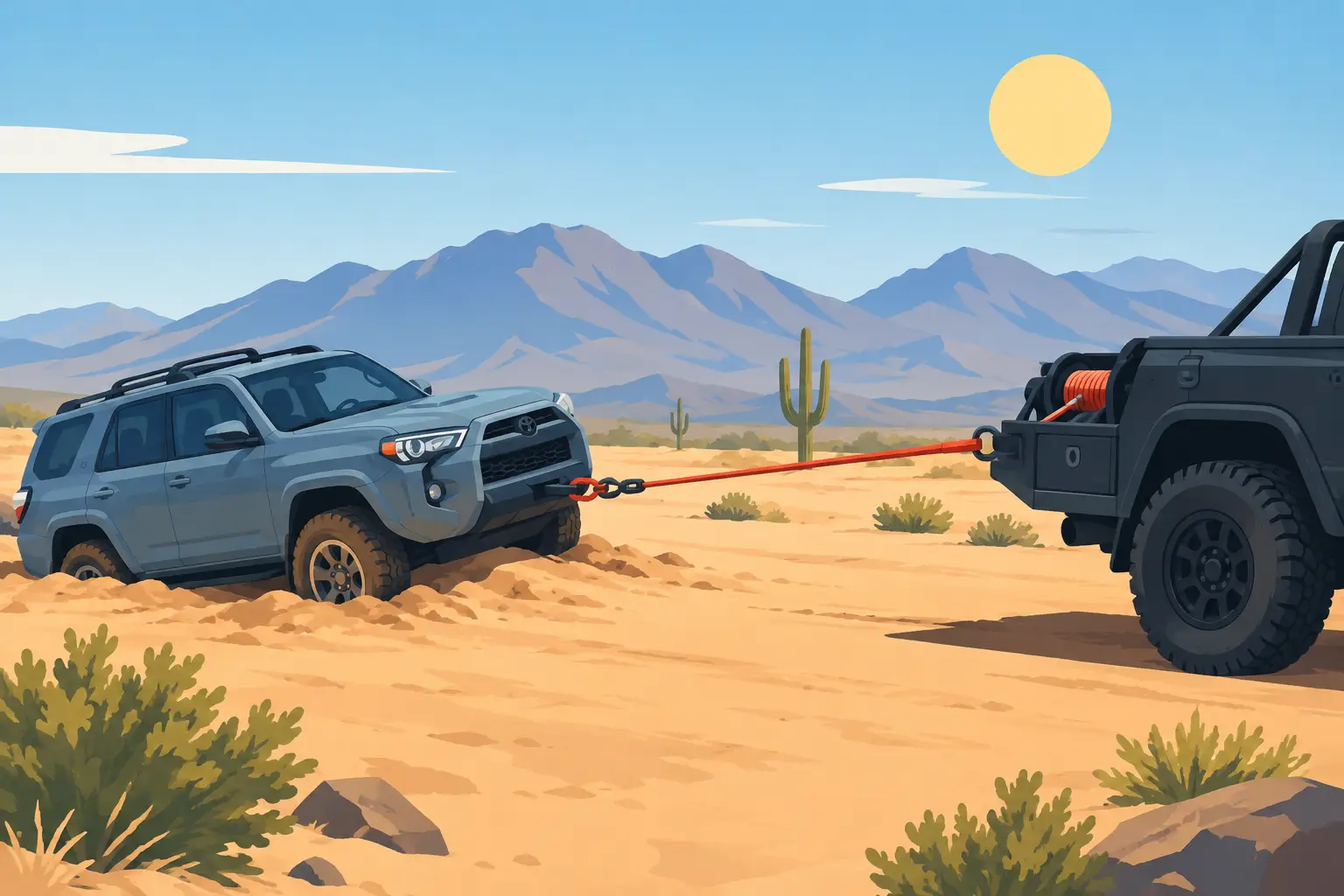
A desert recovery example can start with something as ordinary as pulling a little too far off a graded road. One moment, the SUV is parked near a trailhead or a job site outside Surprise. The next, the rear tires have sunk into loose sand, the vehicle is angled toward a wash, and every attempt to drive out digs the tires deeper.
That is when a routine tow becomes a recovery job. Desert terrain changes the rules. Sand shifts under load, dry washes can hide soft edges, and the heat turns a long wait into a serious concern. A safe extraction depends on controlling the vehicle, choosing solid recovery points, and using the right equipment before more damage is done.
A Desert Recovery Example From the West Valley
Consider a common scenario: a pickup leaves a maintained dirt road near Waddell to turn around beside an open desert lot. The driver steers onto what looks like firm ground, but the front end drops into a soft patch of sand. The rear tires spin, the truck settles lower, and the frame begins to drag.
At that point, adding throttle is usually the wrong move. Spinning tires can build ruts quickly, bury the axle, overheat the transmission, and throw sand under the vehicle. If the truck is towing a trailer, carrying tools, or sitting at an angle, the risk increases. The goal is no longer to power out. The goal is to recover the vehicle without pulling it sideways, damaging its suspension, or putting anyone in the path of a loaded recovery line.
A trained recovery operator begins by assessing the scene. That means looking at the vehicle’s position, how deep it has settled, the direction of the safest exit, access for the recovery truck, and whether a stable anchor point is available. The best pull is not always the shortest one. Often, it is the one that keeps the vehicle moving straight and uphill onto firmer ground.
What a Safe Winch-Out Actually Requires
A desert winch-out is not simply attaching a cable and pressing a button. Recovery equipment produces serious force, especially when a vehicle is stuck to the frame or working against an incline. Proper setup protects the stranded vehicle, the operator, and everyone nearby.
Stop digging before help arrives
If your vehicle is safely out of traffic and there is no immediate hazard, stop spinning the tires. Put the vehicle in park, set the parking brake if appropriate for the terrain, and move passengers to a safe location away from the recovery path. On a narrow shoulder, near a wash, or in an area with poor visibility, stay aware of passing traffic and do not stand downhill from the vehicle.
A driver can provide useful information when calling for help: the nearest cross street, trail access point, landmark, vehicle type, whether it is two-wheel or four-wheel drive, and whether a trailer or equipment is attached. In remote desert areas, a dropped map pin or coordinates can make a major difference, but a phone battery and signal are not guaranteed. Sharing your location early is smart.
Use approved recovery points
The recovery line must connect to a suitable manufacturer-designed recovery point, frame-mounted point, or other appropriate structural location. A bumper, trailer hitch ball, suspension component, or random underbody part may not be designed for the load. Improvised connections can bend components or become dangerous if they fail under tension.
For specialty vehicles, low-profile cars, classic trucks, motorcycles, and luxury SUVs, the attachment and loading plan matters even more. A recovery that gets the vehicle unstuck but damages a fascia, wheel, undertray, or steering component is not a successful recovery. Soft straps, careful line angles, and flatbed-capable equipment help reduce that risk.
Create a controlled pull
The recovery vehicle needs stable footing and enough room to work. Depending on the situation, an operator may position on firm ground, use a winch line, and make a gradual, controlled pull rather than jerking the stuck vehicle free. The driver may be asked to steer gently or apply very light power at the right moment, but only after clear instructions.
Everyone not involved in the operation should stay clear of the line and recovery zone. A winch cable or strap under load deserves space. There should be no spectators standing between vehicles, beside the line, or directly in front of the stuck vehicle. This is one reason professional recovery is often safer than trying to improvise with a buddy’s pickup and a chain.
When a Tow Is Better Than Another Pull
Not every stuck vehicle should be driven away after a winch-out. If a vehicle has bottomed out hard, overheated, lost traction-control function, damaged a tire, or developed a fluid leak, it may need a tow rather than another attempt to continue down the trail.
This decision also depends on the road ahead. A vehicle recovered from one patch of sand may still face several miles of loose terrain. If the route is unknown, the weather is worsening, or daylight is fading, the safer option may be to load the vehicle and transport it to pavement, home, a repair facility, or a trailhead with reliable access.
For low-clearance vehicles, this is especially important. Desert roads can develop washboarding, deep ruts, exposed rock, and washouts after storms. A flatbed tow can prevent a minor stuck situation from becoming underbody, tire, or suspension damage.
Common Desert Recovery Mistakes to Avoid
Most difficult extractions become worse because drivers feel pressured to solve the problem quickly. The desert is quiet, hot, and unforgiving, which can make people take shortcuts. Avoid these common mistakes:
- Repeatedly spinning the tires until the vehicle sinks to the frame.
- Attaching a strap or chain to a hitch ball, bumper, or non-rated component.
- Standing near a tensioned tow strap, winch line, or vehicle path.
- Using excessive throttle when the vehicle is tilted, buried, or connected to a trailer.
- Leaving the main road without enough water, fuel, phone charge, and a way to share your location.
The right approach depends on the vehicle and terrain. A lightly stuck sedan near a maintained roadway may need a simple pull to firm ground. A loaded work truck in deep sand, an SUV at the edge of a wash, or a vehicle that has slid off an embankment requires a more deliberate recovery plan.
Why Local Recovery Equipment Matters
West Valley recovery calls are not limited to off-road trails. Vehicles get stuck in sandy construction access roads, undeveloped lots, canal-side areas, ranch entrances, and shoulders softened by rain. Contractors may need a work truck, skid steer, trailer, or light equipment moved after it loses traction. Motorists can find themselves off the pavement after swerving to avoid traffic, stopping for a breakdown, or taking a shortcut that turns out to be impassable.
The recovery truck must be able to reach the scene and work safely once it arrives. Winching capability, proper straps, stable positioning, and experienced operation matter more than a quick pull from the first available vehicle. Pride Transport & Towing responds across Surprise, the West Valley, and the broader Metro Phoenix corridor with 24/7 dispatch for recovery and towing needs.
Be Ready Before You Leave Pavement
Desert travel does not require an extreme off-road trip to create a recovery risk. Even drivers heading to a work site, shooting location, trailhead, or open lot should plan for changing ground conditions. Keep water in the vehicle, maintain a charged phone, carry basic tire and roadside supplies, and avoid driving into washes or unknown soft areas alone.
If you do get stuck, protect the vehicle and the people with you by stopping early, staying calm, and calling for equipment that matches the situation. A careful recovery gets you back on solid ground with far less risk than one more hard press of the accelerator.