A tow truck cannot always drive up, hook on, and pull a vehicle away. If your car is buried in desert sand, sitting in a drainage ditch, nose-down on an embankment, or blocked by terrain, the question becomes: when is a winch needed instead of a standard tow? The answer comes down to access, traction, vehicle position, and whether moving it without controlled pulling could cause more damage.
A winch is a powered recovery system that uses cable or synthetic line to pull a vehicle gradually toward the recovery truck or onto a flatbed. It is not simply a stronger tow. Used correctly, it allows an operator to control the angle, speed, and direction of the recovery when the vehicle cannot safely roll or be reached by ordinary towing equipment.
When Is a Winch Needed?
A winch is generally needed when the vehicle is unable to move under its own power and cannot be safely attached to a tow truck from a normal loading position. That can happen after an accident, a mechanical failure, an off-road mishap, or one wrong turn onto soft ground.
The clearest example is a vehicle that has left the roadway. A car in a ditch may be close to the pavement but still be impossible to load directly because the truck cannot safely position beside it. A controlled winch-out lets the operator recover the vehicle up the slope, keep it aligned, and reduce the chance of dragging it sideways into another obstacle.
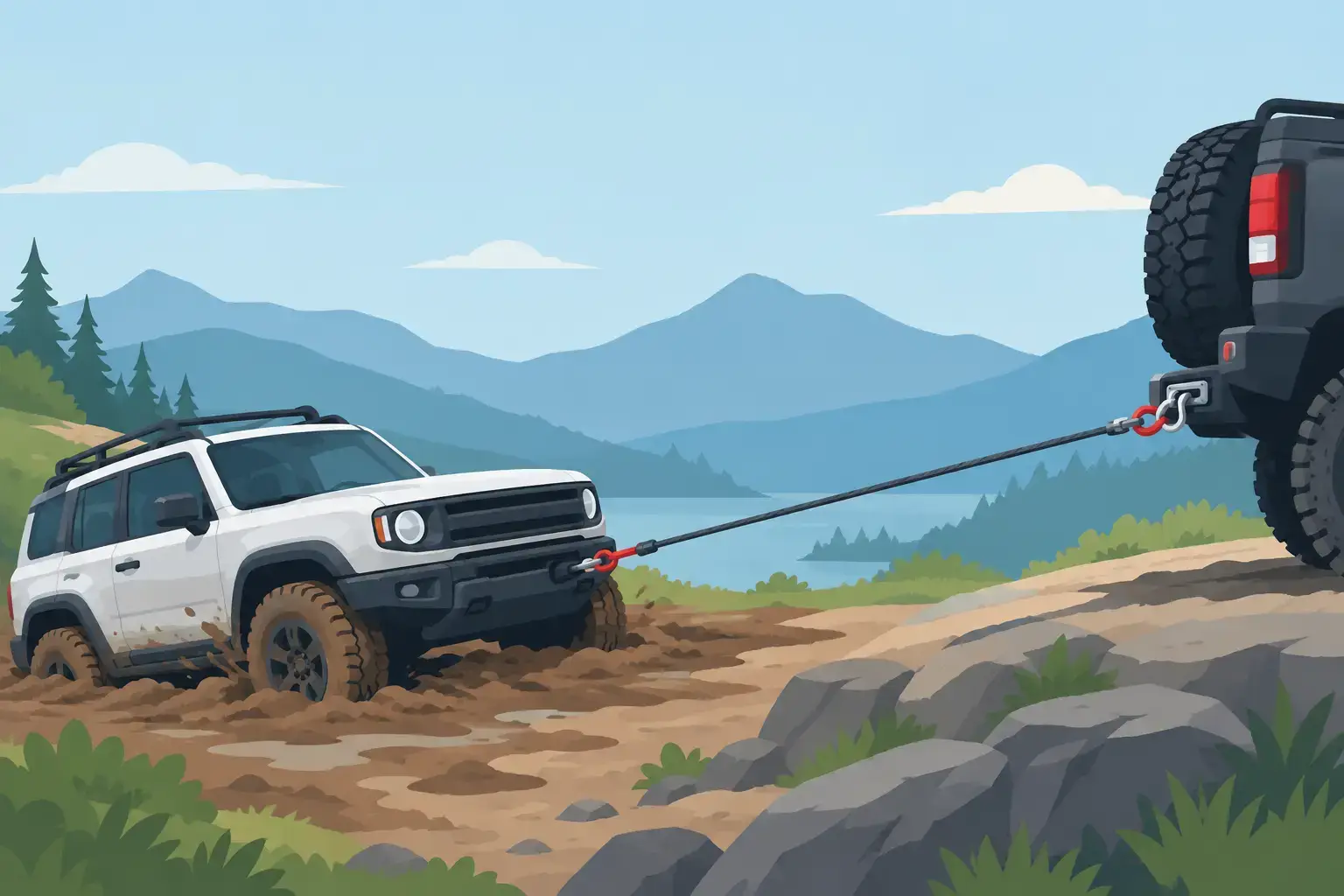
Winching is also common in the West Valley after vehicles get stuck in loose sand, gravel, mud, or wash crossings. Metro Phoenix roads are dry most of the year, but monsoon runoff can change conditions quickly. Soft shoulders, flooded low spots, and unpaved access roads can trap a vehicle even when it looks like it is only a few feet from solid pavement.
Your Wheels Have Lost Traction
If the drive wheels spin without moving the vehicle forward or backward, a winch may be the safer option. Continuing to accelerate can dig tires deeper into sand or mud, overheat the transmission, damage tires, or leave the vehicle resting on its underbody.
This applies to passenger cars, SUVs, pickups, and commercial vehicles. Four-wheel drive helps in some situations, but it does not eliminate the risk of getting stuck. Once a vehicle is high-centered or the tires have dug deep ruts, more throttle usually makes the recovery harder.
The Vehicle Is Off the Road or Below Grade
A vehicle that slides into a ditch, ravine, canal bank, or steep shoulder often requires a winch because gravity and terrain are working against the recovery. The operator needs to consider the slope, soil condition, vehicle weight, traffic, and the location of safe attachment points before any pull begins.
A rushed pull can shift the vehicle, load the suspension unevenly, or cause it to roll farther. Professional recovery uses a planned pull line and controlled tension, not a hard jerk on a chain or strap.
There Is No Safe Way to Back the Truck Into Position
Sometimes the vehicle is on pavement, but a tow truck still cannot get close enough for a normal hookup. This can occur in parking garages, narrow driveways, apartment complexes, construction areas, congested crash scenes, and freeway shoulders with limited working space.
Winching gives the recovery operator distance. The truck can remain in a safer, more stable position while the vehicle is pulled into a location where it can be loaded properly. On busy corridors such as I-10, US-60, Loop 303, and I-17, that extra control can make a major difference for everyone at the scene.
Winching for Low-Profile, Luxury, and Classic Cars
A winch is often the right loading method for vehicles that are not stuck at all. Low-clearance cars, exotic vehicles, classics, collector cars, and modified vehicles may need to be winched onto a flatbed because driving them up loading ramps can scrape bumpers, splitters, exhaust components, or body panels.
The goal is not to pull the vehicle aggressively. It is to bring it onto the bed slowly and in a straight line, using the correct attachment method and ramp approach. Soft straps, careful wheel positioning, and appropriate loading angles matter as much as the winch itself.
For a vehicle that has been in a collision, winching can also be necessary if steering is damaged, a wheel is locked, the transmission cannot be shifted properly, or the engine will not run. Trying to force a disabled vehicle to roll may worsen existing damage. A flatbed recovery with controlled winching is usually the more damage-conscious choice.
What Makes a Winch-Out More Complex?
Not every recovery requires the same amount of equipment or planning. A vehicle lightly stuck in level sand is very different from a vehicle tilted in a ditch with traffic nearby. The recovery plan depends on vehicle weight, how deeply it is stuck, the pull distance, the terrain, and whether there is a reliable anchor point or truck position.
Operators also inspect where the recovery line can be attached. Factory tow points may be appropriate in some situations, but not all. Suspension components, bumpers, axles, and steering parts are not automatically safe attachment points. Incorrect attachment can bend or tear parts from the vehicle, especially when the vehicle is loaded against a slope or sunk into soft terrain.
The recovery angle matters as well. Pulling straight is usually preferable, but real-world scenes do not always allow it. An experienced operator adjusts the truck placement and recovery approach to limit side loading and keep the vehicle stable throughout the pull.
Why a Tow Strap and Another Vehicle Are Not Always the Answer
It is tempting to call a friend with a truck and a tow strap. In a simple, level situation with proper recovery points and experienced people, that may appear easy. But many winch-out calls begin after an improvised pull failed.
Tow straps can snap, hooks can become dangerous projectiles, and sudden force can damage the vehicle being recovered. Pulling from a bumper, hitch ball, or unknown attachment point creates unnecessary risk. The problem becomes more serious near traffic, deep water, steep terrain, utility structures, or unstable ground.
If your vehicle is stuck, avoid spinning the tires or repeatedly rocking it until the vehicle bottoms out. Keep people away from the pull path, do not stand near a tensioned strap or cable, and avoid getting underneath the vehicle to attach anything. If the vehicle is in a dangerous location, move to a safe area away from traffic when possible and wait for professional help.
What to Tell a Recovery Dispatcher
Clear information helps the right truck and equipment arrive prepared. Let the dispatcher know whether the vehicle is on pavement, in sand, in a ditch, off a trail, or involved in a collision. Mention if the vehicle is low, all-wheel drive, four-wheel drive, modified, loaded with tools or cargo, or unable to roll.
It also helps to describe the nearest cross street, freeway exit, landmark, gate, or trail access point. If it is safe to do so, photos of the vehicle position and surrounding terrain can help determine whether a standard tow, flatbed, or dedicated winch-out is needed.
Pride Transport & Towing provides 24/7 recovery support across Surprise, the West Valley, and surrounding Metro Phoenix routes. The right response is not always the fastest-looking pull. It is the one that gets your vehicle back to solid ground or onto the truck without creating a second problem.
If you are unsure whether your situation calls for a winch, treat loss of traction, off-road position, damaged wheels, limited access, and low clearance as reasons to ask before anyone tries to pull the vehicle. A careful recovery at the start is usually far less expensive than repairing damage caused by the wrong one.