A dead battery in a Surprise parking lot calls for a different response than a disabled vehicle on Loop 303. Understanding roadside assistance versus towing helps you request the right service, avoid unnecessary delays, and make a safer decision when your vehicle will not move.
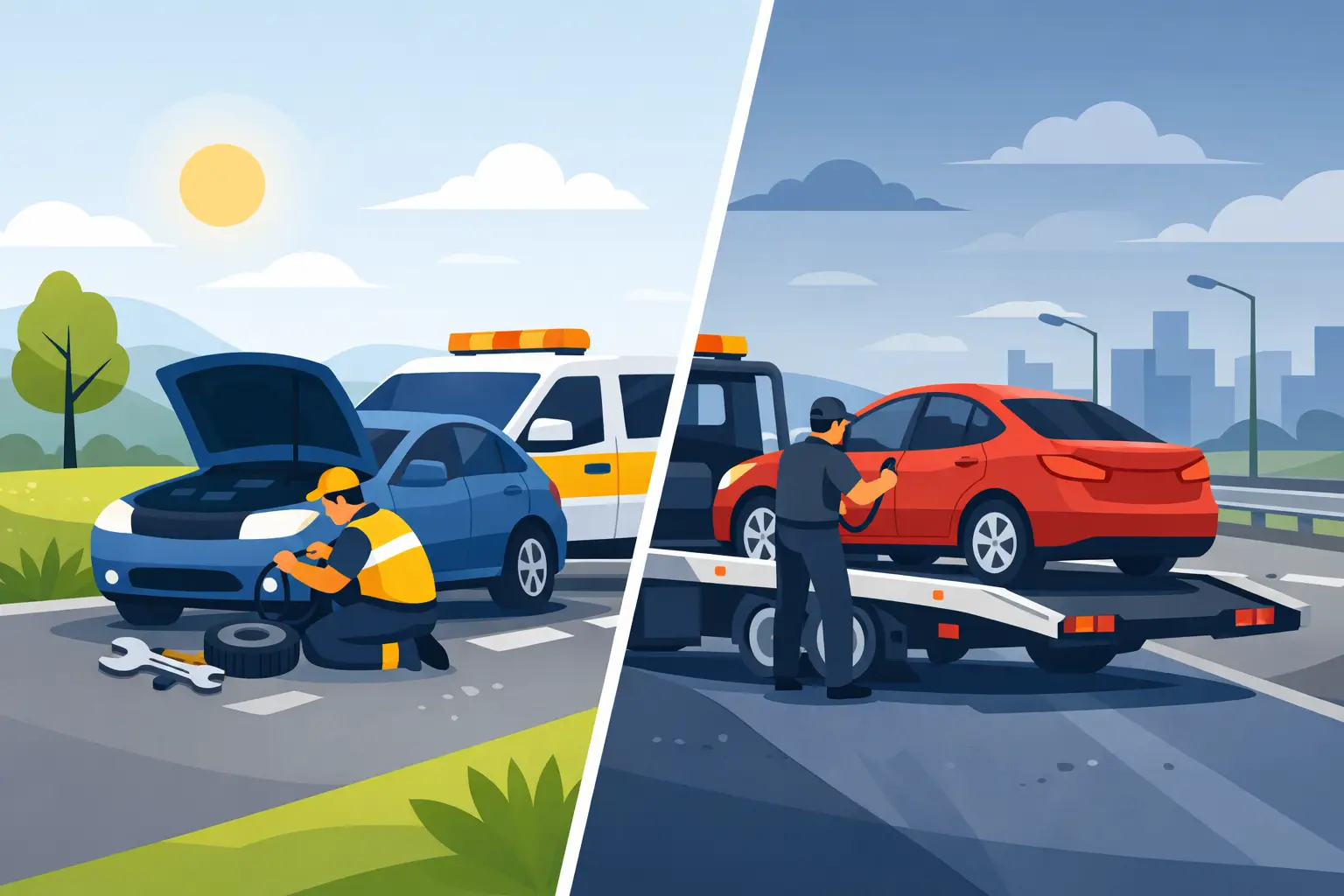
The simple distinction is this: roadside assistance is meant to correct a minor problem where the vehicle can safely continue driving. Towing is for situations where the vehicle cannot, should not, or is not safe to drive. The details matter, especially in West Valley heat, freeway traffic, and situations involving low-clearance, luxury, classic, or damaged vehicles.
What Roadside Assistance Is Designed to Do
Roadside assistance addresses problems at the vehicle’s location. The goal is to get you moving again without transporting the vehicle. A trained operator arrives with the tools needed to assess the issue and perform a practical on-site service.
A jump start is a common example. If the battery is discharged because a light was left on, a jump may get the engine running and allow you to drive home, to work, or directly to a repair shop. A lockout service is another. When keys are inside the vehicle, careful entry can solve the problem without breaking glass or damaging the door.
Flat-tire service can also be roadside assistance, provided you have a usable spare tire and the vehicle can be driven safely after it is installed. The same applies to a small amount of fuel delivery, where available, when an otherwise healthy vehicle simply ran out of gas.
Roadside service is usually the right call when all three conditions are true: the problem is isolated, the vehicle can be made safe at the roadside, and you will be able to drive it safely after the service is complete. A good operator does not just get the engine to turn over or the wheel back on the car. They consider whether the vehicle is actually roadworthy before recommending that you continue.
Common Roadside Assistance Calls
Roadside help is often appropriate for a dead battery, keys locked inside, a flat tire with a good spare, or a minor issue that does not affect steering, braking, tires, cooling, or visibility. It can be the faster and more cost-effective option when the repair is straightforward.
Still, roadside assistance has limits. A jump start does not repair a failing battery, alternator, or electrical issue. A spare tire is not a long-term solution for many vehicles, and it may not be safe for freeway speeds. If the same issue has happened more than once, or warning lights remain on after service, towing to a qualified shop may be the wiser move.
When Towing Is the Safer Choice
Towing moves a vehicle when driving it could create more damage, leave you stranded again, or put you and other motorists at risk. It is not only for major collisions. Many mechanical failures require towing even when the car looks normal from the outside.
Call for a tow when the engine will not start after a proper attempt to diagnose the battery, when the vehicle is overheating, when a tire is badly damaged and there is no safe spare, or when you have a fuel, oil, transmission, steering, brake, or suspension problem. A vehicle with an illuminated temperature warning, leaking fluid, smoke, unusual grinding, or a severe vibration should not be driven just to save the cost of a tow.
Collision damage is another clear towing situation. Even a low-speed impact can damage a wheel, tire, radiator, alignment components, lights, or sensors. If a bumper is hanging, a wheel is pointing the wrong direction, a fluid is leaking, or the vehicle does not track straight, it needs professional transport.
Towing is also the right choice when your vehicle is in an unsafe location. A breakdown on I-10, US-60, I-17, or a busy surface street can become dangerous quickly. Getting the vehicle off the roadway and to a secure destination is often more important than attempting a temporary repair in traffic.
Flatbed Towing Protects Certain Vehicles
Not every tow method is appropriate for every vehicle. Flatbed-capable towing is often the preferred approach for all-wheel-drive vehicles, vehicles with serious damage, motorcycles, low-profile cars, and vehicles with limited ground clearance.
Classic, collector, luxury, and exotic vehicles deserve additional planning. The loading angle, tie-down method, wheel position, and clearance all matter. Soft-strap securement helps avoid contact with delicate suspension components, painted surfaces, and bodywork. For an owner who has spent years protecting a collector car, the right transport process is not an extra. It is the standard that protects the vehicle from avoidable damage.
Roadside Assistance Versus Towing: A Quick Decision Check
Before you call, take a calm look at the situation from a safe location. Ask whether the vehicle can be repaired on site and driven without risk. If the answer is uncertain, towing is usually the safer choice.
Roadside assistance makes sense when the vehicle has a minor, contained issue and can safely leave under its own power. Towing makes sense when there is a mechanical failure, collision damage, recurring issue, dangerous warning sign, or unsafe location.
For example, a battery that died overnight may only need a jump start. But if the battery warning light came on while driving, the charging system may have failed. A jump could start the engine, yet the vehicle may stall again miles later. In that case, a tow prevents a second breakdown and protects you from being stuck in a worse location.
A flat tire follows the same logic. If the spare is properly inflated, the lug nuts are accessible, and the tire damage is limited, a tire change may get you moving. If the vehicle has no spare, multiple tires are damaged, the wheel itself is bent, or you are stopped on a narrow freeway shoulder, towing is the safer call.
What to Tell the Dispatcher
Accurate information helps the right truck and equipment arrive the first time. Give the dispatcher your exact location, closest cross streets or freeway mile marker, vehicle year, make, model, and color. Explain what happened and whether the vehicle is in a parking lot, driveway, traffic lane, shoulder, ditch, or off-road area.
Mention anything that affects handling. Tell them if the vehicle is all-wheel drive, lowered, electric, heavily damaged, has a locked wheel, or is a motorcycle. If it is a classic or exotic vehicle, say so before dispatch. Specialty vehicles may require a flatbed, soft straps, careful ramp placement, or another damage-conscious loading approach.
If you need towing, provide the destination if you have one. That may be your home, a repair facility, dealership, body shop, or another secure location. If you are unsure where the vehicle should go, focus first on getting it safely out of danger.
Stay Safe While You Wait
Your first job is not diagnosing the vehicle. It is protecting yourself. Pull as far from moving traffic as conditions allow, turn on hazard lights, and avoid standing between your vehicle and traffic. On a busy freeway, remain inside with seat belts fastened when it is safer than exiting. If you must leave the vehicle due to fire, smoke, or an immediate hazard, move well away from traffic and the vehicle.
Do not crawl beneath a disabled vehicle, attempt repairs in an active traffic lane, or continue driving on an overheating engine or shredded tire. A short distance can turn a manageable repair into major engine, wheel, or body damage.
For drivers throughout Surprise, Peoria, Glendale, Sun City, Waddell, and the broader Metro Phoenix corridor, the best request is the one that matches the problem. Pride Transport & Towing provides 24/7 dispatch for both roadside help and professional towing, including recovery situations that go beyond a standard breakdown.
When you are deciding between a quick roadside fix and a tow, choose the option that gets you out of danger without asking a damaged vehicle to do more than it safely can.