
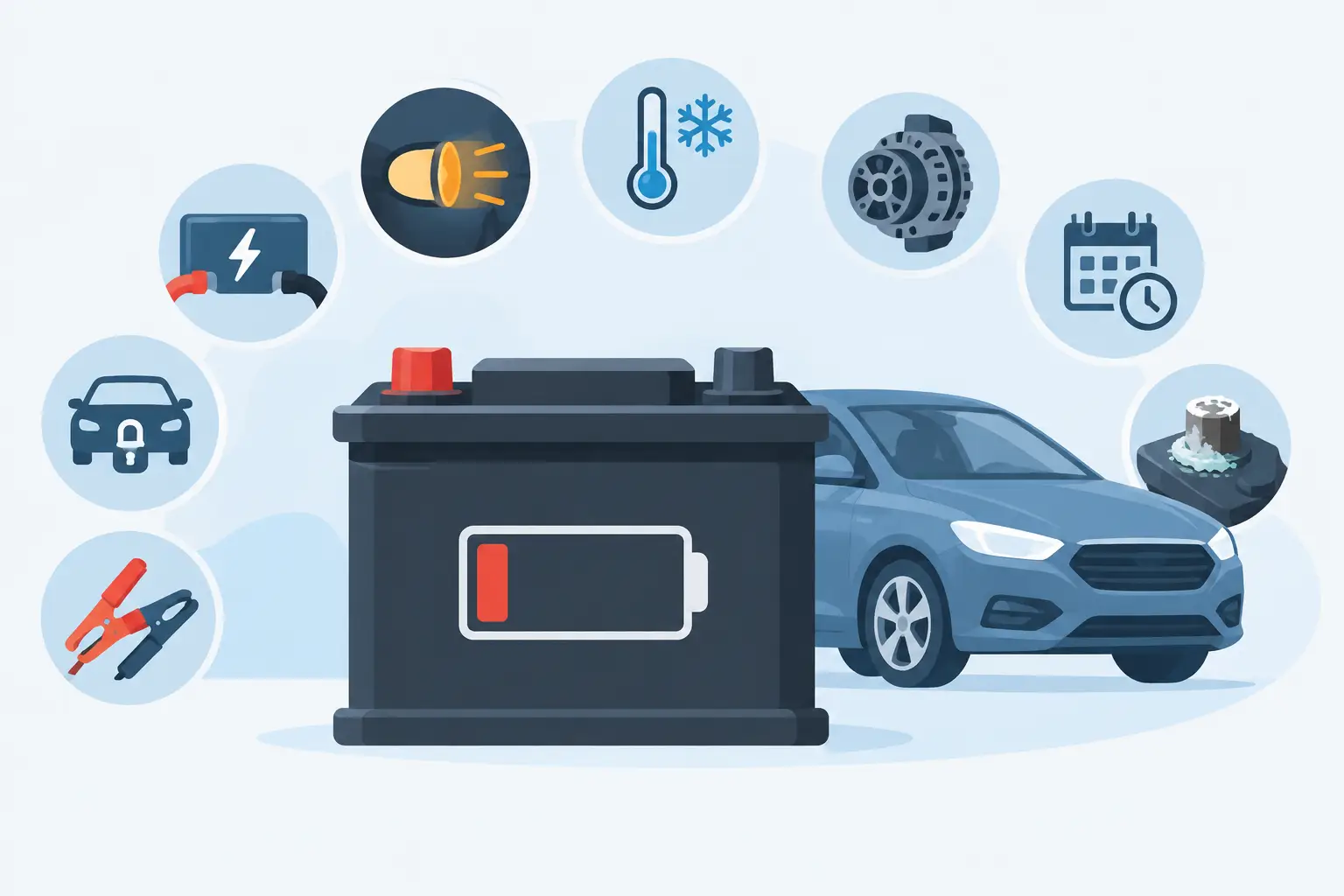
A car that ran perfectly yesterday can leave you stuck in a driveway, parking lot, or on the shoulder this morning. Why does car battery die so suddenly? In many cases, the battery was weakening long before the no-start happened. Arizona heat, short trips, an interior light left on, corroded connections, and charging-system trouble can all push a marginal battery over the edge.
A dead battery is frustrating, but it is also a useful clue. The key is figuring out whether the battery simply needs a proper charge, has reached the end of its service life, or is being drained by another problem in the vehicle.
Why Does a Car Battery Die Without Warning?
A battery stores electrical power for starting the engine and running vehicle systems when the engine is off. Once the engine is running, the alternator should recharge the battery and supply power to lights, ignition components, climate controls, and electronics.
When that balance breaks down, the battery loses the reserve needed to crank the engine. Sometimes the warning is obvious: slow cranking, dim headlights, or a battery warning light. Other times, especially after a hot Arizona day, the first clear sign is a click when you turn the key or press the start button.
Arizona heat shortens battery life
Extreme heat is hard on automotive batteries. Heat accelerates the chemical reactions inside the battery and can cause internal components and battery fluid to deteriorate faster. A battery that might last several years in a mild climate may have a shorter, less predictable life in Surprise, Peoria, Glendale, and across the West Valley.
The problem often shows up after the battery has been heat-stressed for months. It may still start the car during normal use, then fail after a quick stop at a store or an afternoon parked in direct sun. If your battery is more than three years old, have it tested before relying on it through another summer.
Something stayed on after the vehicle was parked
Headlights, cabin lights, trunk lights, phone chargers, dash cameras, and accessories can drain a battery when the engine is off. Some newer vehicles also keep modules active for a short time after locking. That is normal. What is not normal is a vehicle that continues drawing significant power for hours or overnight.
An obvious light left on can drain even a healthy battery. A smaller electrical draw may take longer and be harder to find. If the battery repeatedly dies after sitting overnight or for a day or two, the issue may be a parasitic draw from an accessory, wiring fault, relay, or electronic module that is not going to sleep properly.
Corroded or loose battery connections interrupt power
Battery terminals need a clean, tight connection. White, blue, or green buildup around the terminals is corrosion, and it can restrict current flow even when the battery itself still has a charge. A loose terminal can create similar symptoms: intermittent starting, flickering electrical accessories, or a vehicle that goes completely dead after a bump.
Do not assume a battery is bad just because the dash does not light up. A technician can inspect the cable ends, ground connection, and terminal condition before replacing parts unnecessarily.
The alternator may not be recharging the battery
A jump start can get your vehicle moving, but it does not prove the charging system is working. If the alternator is weak or failing, the battery may lose power while you drive. You may notice a battery-shaped warning light, dimming headlights, erratic gauges, a burning smell, or electrical features that begin shutting down.
If the vehicle starts with a jump but dies again shortly afterward, avoid repeated jump-start attempts and have the charging system checked. Continuing to drive with low voltage can leave you stranded in traffic and may affect sensitive vehicle electronics.
Short drives may not replace the power used to start
Starting an engine uses a large burst of battery power. A few very short trips, especially with air conditioning, lights, infotainment, and charging devices running, may not give the alternator enough time to fully restore that energy.
This is more common with vehicles that sit during the week and only travel a few miles at a time. It does not mean every short-trip driver needs a new battery, but it does mean an aging battery has less margin for error. A longer drive or a properly matched battery maintainer can help when the vehicle will be parked for extended periods.
The battery is old or has an internal failure
All batteries wear out. Internal plates degrade, capacity drops, and a battery can eventually develop a failed cell. At that point, it may show voltage on a basic meter but still lack the power to start the engine under load.
A battery test is more meaningful than voltage alone because it measures how the battery performs when asked to deliver starting power. Swelling or a distorted battery case is also a serious warning sign, particularly in hot climates. Do not jump, charge, or handle a visibly swollen battery without professional guidance.
Cold weather can expose an existing weakness
Metro Phoenix does not see prolonged winter cold like many parts of the country, but cool desert mornings can still reveal a battery that has already been damaged by summer heat. Cold temperatures slow battery chemistry, while engine oil becomes slightly harder to move. The result can be a no-start that seems to come out of nowhere.
The weather may be the trigger, not the root cause. If the battery struggles on a cool morning, test it rather than waiting for the next failure.
Is It Really a Dead Battery?
Not every no-start is a battery problem. A failed starter, bad ignition switch, fuel-system issue, security-system fault, or damaged cable can all prevent the engine from starting. The symptoms matter.
Rapid clicking when you try to start often points to low battery power. One heavy click may indicate a starter or connection issue. If the engine cranks strongly but never fires, the battery may not be the main problem. A battery warning light while driving usually points toward the charging system, not necessarily a battery that needs replacement.
These distinctions are why a careful roadside assessment matters. The fastest answer is not always the correct repair.
What to Do When Your Car Battery Dies
First, get the vehicle into a safe position if possible. Turn off lights, climate controls, and accessories. If you are on a busy road, freeway shoulder, or unsafe parking area, stay aware of traffic and do not attempt a jump start where you could be exposed to moving vehicles.
If you have jumper cables or a jump pack and know the proper connection points for your vehicle, a jump start may get you moving. Connect positive to positive first. Connect the final negative clamp to a designated ground point on the disabled vehicle, not directly to the battery’s negative terminal unless the manufacturer specifically directs otherwise. Never jump a leaking, cracked, frozen, or swollen battery.
After a successful jump, do not assume the problem is solved. If the vehicle restarts after being driven, arrange for a battery and charging-system test soon. If it will not hold a charge, stalls after the jump, or keeps dying, it may need towing rather than another attempt.
When Roadside Help Is the Safer Choice
A jump start is not the right answer in every situation. It is better to call for assistance when you are on I-10, US-60, Loop 303, I-17, or another high-speed route; when battery cables are damaged or corroded; when you smell sulfur or see battery swelling; or when the vehicle has died more than once in a short period.
For luxury, classic, exotic, and low-profile vehicles, avoid improvised towing or repeated electrical troubleshooting at the roadside. A proper jump-start assessment or flatbed tow protects the vehicle while giving you a safer path to diagnosis. Pride Transport & Towing provides 24/7 roadside response and towing throughout the West Valley when a dead battery turns into a situation that cannot wait.
A battery failure rarely arrives at a convenient time. Treat slow starts, battery warning lights, and repeated jump-starts as early warnings, and get the system tested before the next stop leaves you waiting for a ride.