
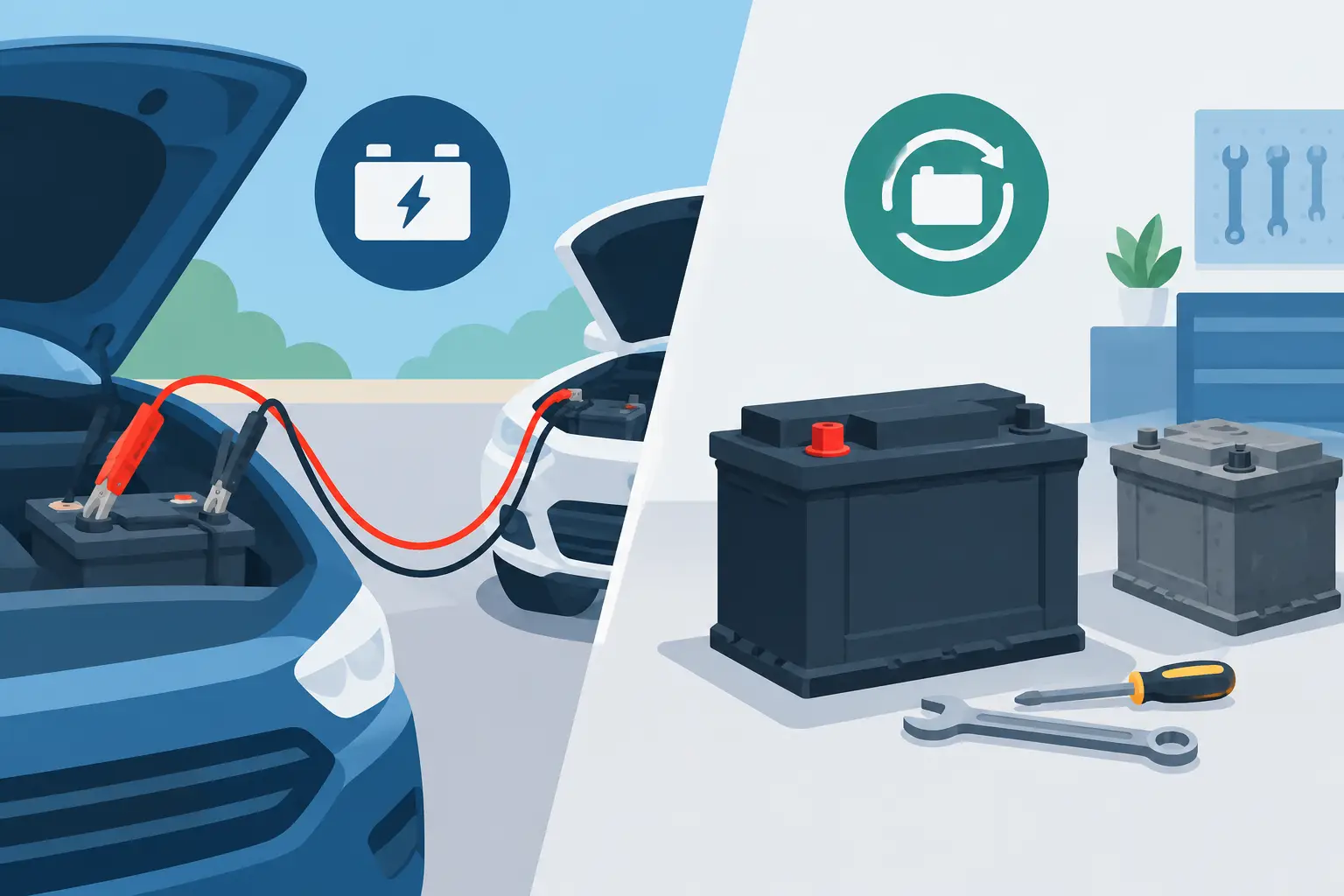
A dead battery on Loop 303, I-10, or in a Surprise parking lot creates one immediate question: do you need a jump, or is it time for a new battery? The jump start versus replacement decision can save time and prevent another roadside breakdown, but the answer depends on why the battery went dead in the first place.
A jump start may get your vehicle moving again. It does not repair a worn-out battery, a failing alternator, loose battery connections, or an electrical drain. Before you assume the problem is solved, look at the battery’s age, what happened before it died, and whether the vehicle keeps running after the jump.
When a Jump Start Is the Right First Move
A jump start is usually reasonable when the battery was drained by a clear, one-time event. Maybe an interior light was left on overnight, a door did not close completely, or accessories were used while the engine was off. In these cases, the battery may still be healthy enough to recharge once the engine and charging system are operating normally.
It can also make sense when the battery is relatively new and the vehicle has otherwise started reliably. If your car starts normally after the jump and continues to restart later that day, the issue may have been an accidental drain rather than battery failure.
Even then, do not treat a successful jump as proof that everything is fine. A battery that was deeply discharged can take a long time to recover through normal driving, especially if the trip is short. Letting the engine idle for a few minutes is not the same as fully charging the battery. If possible, have the battery and charging system tested soon, particularly before a long trip or during Arizona’s hottest months.
Jump Start Versus Replacement in Arizona Heat
Heat is hard on vehicle batteries. West Valley summers accelerate the chemical wear inside a battery, causing it to lose its ability to hold a charge and deliver enough power to start the engine. A battery can seem fine one week, then struggle or fail once temperatures climb.
Most car batteries last roughly three to five years under favorable conditions. In the Phoenix area, many batteries reach the end of their useful life sooner. A battery that is three years old or older deserves closer attention if it has started cranking slowly, needed a jump, or shown corrosion around the terminals.
The key difference is capacity. A weak battery may accept enough power from a jump to start the vehicle, but it may not have enough reserve power to restart after you stop for fuel, park at work, or turn off at home. That is when a roadside jump becomes a repeat problem instead of a one-time solution.
Signs Replacement Is the Better Call
Replacement is often the safer choice when the battery has already shown a pattern of failure. One jump after a known drain is one thing. Multiple jump starts in a short period point to a battery that is no longer dependable or another issue that needs diagnosis.
Pay attention to slow, labored cranking. If the engine turns over more slowly than usual, especially in the morning, the battery may be losing strength. Dim headlights, flickering interior lights, a clock or radio that resets, and repeated clicking when you turn the key are also common low-voltage warnings.
Visible battery condition matters too. Swelling or bulging on the battery case can indicate heat damage and requires prompt replacement. Heavy corrosion can interfere with the connection at the terminals, though corrosion alone does not always mean the battery itself has failed. Loose terminal clamps can cause the same no-start symptoms as a dead battery.
A battery that is beyond its expected age, repeatedly loses charge, or fails a professional load test should be replaced rather than repeatedly jumped. The cost and inconvenience of another no-start often outweigh the short-term benefit of squeezing a few more weeks out of an unreliable battery.
A Jump Will Not Fix Every No-Start
Not every vehicle that will not start has a battery problem. If the engine starts after a jump but dies shortly afterward, or if the battery warning light remains on while driving, the alternator or charging system may not be keeping the battery charged. Continuing to drive can leave you stranded once the remaining battery power is gone.
An engine that cranks normally but will not start may have a fuel, ignition, security-system, or engine-management issue instead. In that situation, another jump is unlikely to help. Likewise, a single click or no response can be caused by a starter problem, damaged cable, bad connection, or a vehicle that is not fully in Park or Neutral.
For newer vehicles, low voltage can also trigger multiple warning lights or unusual electronic behavior. That can look alarming, but it still needs proper testing rather than guesswork. Replacing a battery without checking the charging system can mean the new battery is drained by the same underlying fault.
What to Do Before Calling for Help
If you are parked safely, start with a quick visual check. Make sure the gear selector is firmly in Park, set the parking brake, and turn off lights, climate controls, chargers, and other accessories. Look for obviously loose battery cables, but do not touch a swollen, cracked, leaking, or badly damaged battery.
Do not attempt a jump if you are in an unsafe traffic position, on a narrow shoulder, or near moving freeway traffic. Calling for professional roadside assistance is the better move when visibility is poor, traffic is fast, or you do not have the proper equipment and experience.
If you use jumper cables, follow the vehicle manufacturer’s procedure and keep sparks away from the battery. Incorrect connections can damage sensitive electronics, create a short circuit, or cause injury. Hybrid, electric, luxury, and late-model vehicles may have specific jump points and procedures, so avoid assuming every vehicle should be handled the same way.
When a Tow Makes More Sense Than Another Jump
There are times when getting the vehicle started is not the goal. If the battery is clearly damaged, the vehicle dies after a jump, the charging warning light is on, or the engine will not stay running, a tow to a repair facility may prevent a second breakdown farther down the road.
This is especially true on major routes around the West Valley. A vehicle that barely starts in a parking lot may not make it safely through traffic on US-60, I-17, or I-10. If there is any question about the alternator, starter, electrical system, or engine operation, secure transport is often the more practical and safer choice.
Pride Transport & Towing provides 24/7 jump starts and towing throughout Surprise and the surrounding Metro Phoenix area. A trained operator can help you get moving when a simple jump is appropriate or arrange a tow when the symptoms point to a problem that should not be driven.
Protect the Next Start, Not Just This One
After a jump, avoid shutting the vehicle off immediately unless you are already at a place where it can be tested or serviced. Drive directly to a trusted battery or repair shop if the vehicle is operating normally, and ask for both a battery test and a charging-system check. A battery test without an alternator check can miss half the problem.
Keep the receipt or installation date for your battery, and have the terminals inspected during routine service. In Arizona, proactive replacement before a failing battery leaves you stranded is often a practical maintenance decision, not an unnecessary expense.
The best roadside choice is the one that gets you home safely without creating another emergency at the next stop.