A skid steer may fit on a trailer, but that does not make it a simple load. These machines carry their weight low, climb steep ramps with force, and can shift quickly if the trailer, ramps, or securement points are wrong. Whether you need to load a skid steer for a jobsite move across the West Valley or transport it farther through Metro Phoenix, the goal is the same: get it on, secure it correctly, and arrive without damaging the machine, trailer, or anyone nearby.
Start With the Right Trailer and Tow Vehicle
Safe skid steer hauling begins before the machine reaches the ramps. Confirm the skid steer’s operating weight with its bucket, forks, grapple, or other attachment installed. The number listed for the base machine is not always the number you are actually hauling. Add the attachment, fuel, accessories, chains, binders, and any tools stored on the trailer.
Then check the trailer’s GVWR, axle ratings, deck condition, ramp capacity, tire condition, and available tie-down points. The tow vehicle must also be rated for the loaded trailer weight and have a properly matched hitch, coupler, safety chains, electrical connection, and trailer brake controller. A trailer that is technically large enough can still be a poor choice if its ramps are too light, too steep, bent, slick, or not rated for tracked equipment.
Weight distribution matters just as much. A skid steer positioned too far forward can overload the tow vehicle’s rear axle and create steering problems. Too far back can cause trailer sway, especially at highway speed or in crosswinds. In most cases, the loaded trailer needs appropriate tongue weight, but the exact machine placement depends on the trailer layout, axle location, attachment weight, and manufacturer guidance.
Before You Load a Skid Steer, Inspect the Site
A level, firm loading area is not a convenience. It is a safety requirement. Avoid loading from soft dirt, loose gravel, a crowned road shoulder, a ditch edge, or an area where one trailer tire sits lower than the other. In Arizona, hard-packed ground can look stable until a ramp digs in or a tire breaks through a softened irrigation line.
Park the tow vehicle and trailer as straight as possible. Set the parking brake, place the transmission in park, chock the trailer wheels when conditions call for it, and lower the ramps fully. Make sure ramps are locked into their loading position and firmly supported. Never improvise with loose boards, blocks, or ramps that are not designed for the machine’s weight.
Walk around the trailer before starting the load. Remove loose tools, debris, rocks, and anything that can interfere with a track or tire. Check overhead clearance if you are loading near a carport, tree branches, utility lines, or jobsite structures. A raised boom or tall attachment can create a clearance problem that is easy to miss from the operator’s seat.
Load Slowly and Keep the Machine Centered
Choose the loading direction based on the machine, attachment, trailer, and manufacturer recommendations. For many skid steers, loading with the heavy end oriented to support correct trailer balance is the priority. That may mean driving forward or backing on. If you are not certain, stop and verify the proper procedure for your specific equipment rather than relying on a general rule.
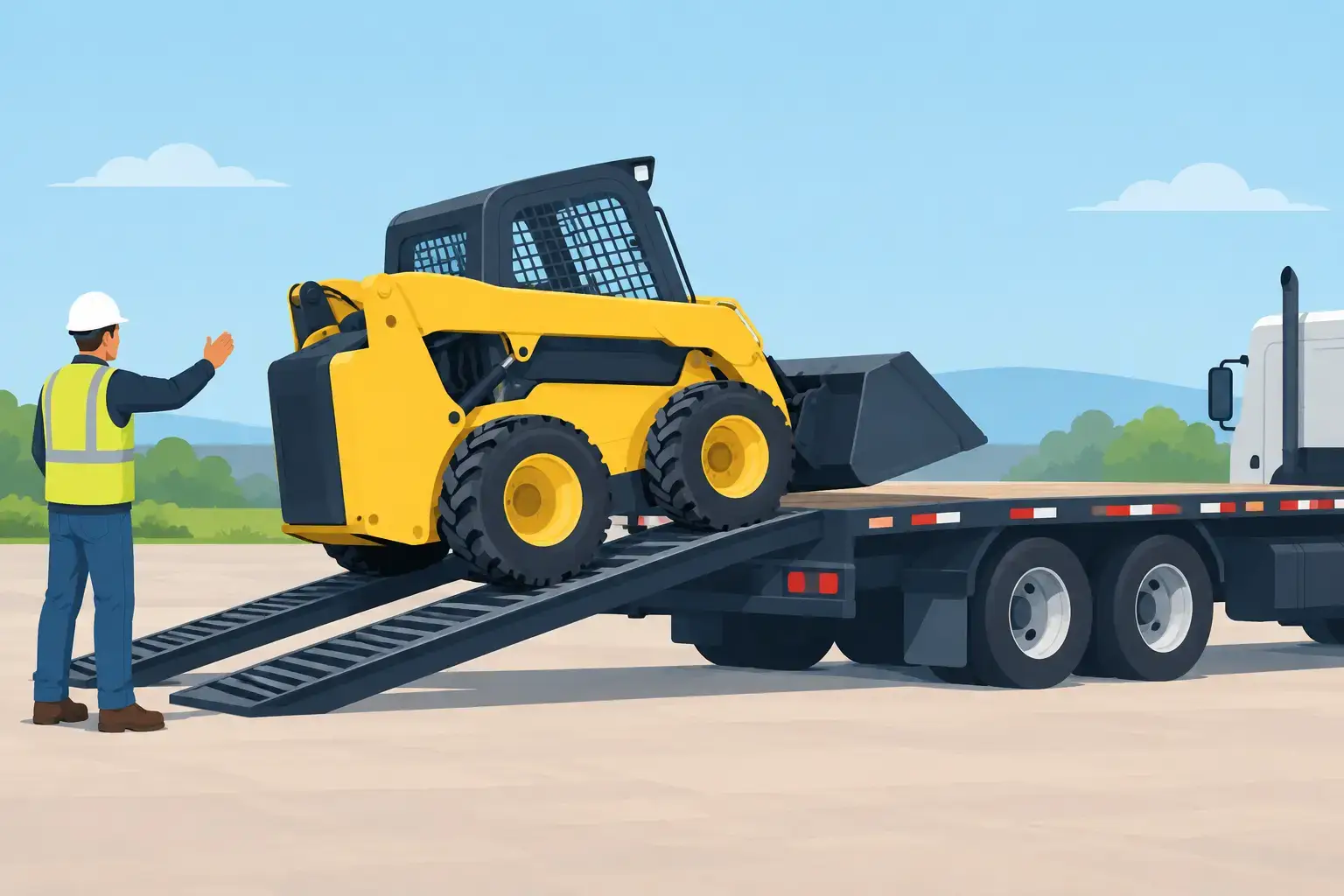
Keep the attachment low during the approach and climb. Travel straight up the ramps at a slow, controlled speed, with no sudden steering corrections. A quick turn on narrow ramps can pull a tire or track off the edge, damage the ramp, or tip the machine. If alignment is off, back down carefully and reset. Do not try to correct a crooked approach halfway up the ramps.
Once the skid steer is on the deck, center it from side to side and position it for safe weight distribution. Lower the bucket or attachment to the trailer deck if the configuration allows, set the parking brake, return the controls to neutral, and shut down the machine. Remove the key when appropriate so no one moves the equipment while you are securing it.
Watch for Attachment and Ground-Clearance Issues
Buckets, trenchers, forks, pallet frames, and grapples change how a skid steer loads and rides. A long attachment can contact the deck, ramps, trailer rail, or pavement during loading. Low attachments can catch at the ramp-to-deck transition. If the attachment makes the loading angle unsafe, use a better-suited trailer, longer ramps, or professional hauling equipment.
Tracks require extra attention. Steel tracks can damage decks and ramps not rated for them, while rubber tracks can slide on wet metal, fine dust, or oil residue. Arizona dust on a trailer deck may not look hazardous, but it can reduce traction at exactly the wrong moment.
Secure the Skid Steer at Approved Points
The machine is not secure because its bucket is on the deck or because the parking brake is set. Transport securement needs properly rated chains, binders, straps, and anchor points that match the equipment and applicable hauling requirements. Use the skid steer’s designated tie-down points whenever available. Avoid wrapping chains around hydraulic hoses, cylinders, attachment arms, or components that can bend or suffer hidden damage.
A common approach is four-point securement, with independent restraints controlling movement in multiple directions. The exact chain size, working load limit, angle, and number of tie-downs depend on the machine weight and the securement system. Every component is only as strong as its lowest-rated part. A heavy chain does not solve the problem if the binder, trailer stake pocket, D-ring, or attachment point is under-rated.
After tightening the binders or ratchets, secure any excess chain or strap so it cannot drag, whip, or contact the road. Check that the attachment is restrained if needed and that nothing can bounce, pivot, or drop during travel. Inspect the load again after the first few miles and at fuel or rest stops. Chains settle, straps can loosen, and a minor shift is far easier to correct in a parking area than on Loop 303, I-10, US-60, or I-17.
Know When Not to Move It Yourself
There is no prize for forcing an equipment move with a trailer that is almost adequate. Professional hauling is usually the better call when the skid steer is oversized for your trailer, has a specialty attachment, cannot run, is stuck in soft ground, has damaged tracks or tires, or must be loaded in a tight residential or commercial space.
The same applies when the route involves heavy traffic, freeway travel, long distance, or a jobsite with poor access. An experienced operator can evaluate trailer angle, recovery points, machine condition, weight placement, and the safest way to handle a non-running unit. If a skid steer is in a ditch, wash, construction excavation, or off-road area, recovery may need to happen before it can be loaded at all.
Pride Transport & Towing provides light equipment hauling and recovery support for skid steers and similar equipment throughout Surprise, the West Valley, and surrounding Metro Phoenix routes. The right truck and trailer setup can prevent a routine equipment move from turning into damaged machinery, a damaged trailer, or a roadside hazard.
A Safe Load Is a Productive Start to the Job
Take the extra minutes to verify weights, inspect ramps, center the machine, and secure it at approved points. If any part of the loading plan feels uncertain – the trailer rating, ramp angle, tie-down setup, site conditions, or route – pause before moving. A safe skid steer load protects the equipment you depend on and helps ensure it is ready to work when it reaches the next jobsite.